
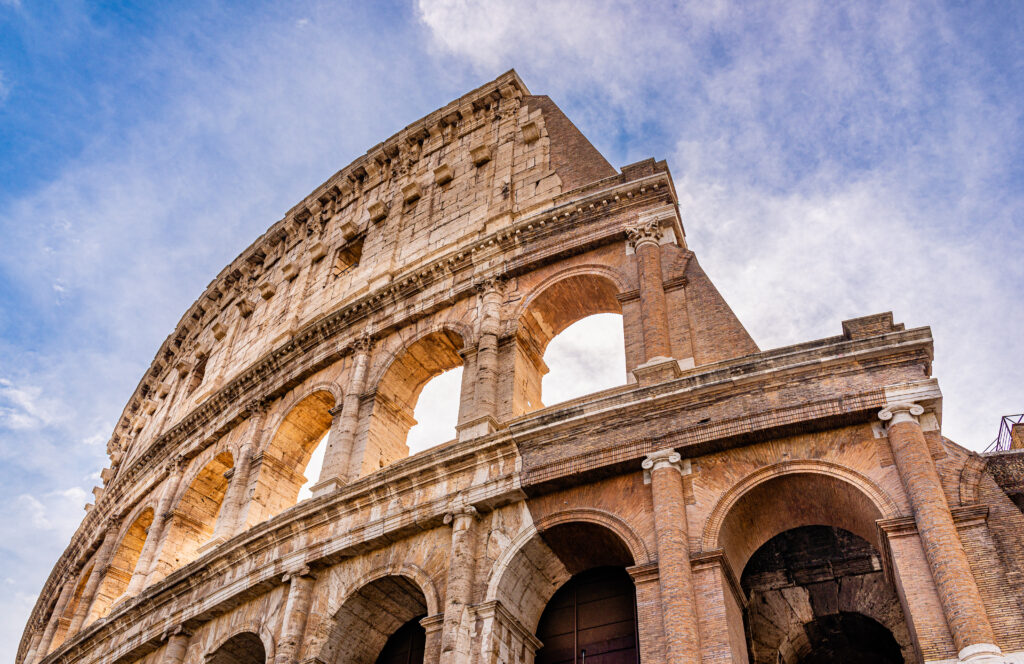
After our Ireland adventure in 2022, my wife and I knew the next big trip had to include my mom and aunt. When I mentioned Rome, their excitement said everything. This would be their first time crossing the Atlantic and the perfect start to a two‑week Europe adventure that ended with a Mediterranean cruise.
Months of planning later, we boarded a flight out of San Diego, connected in Montreal, and landed in Rome with daylight to spare. Jet‑lagged but buzzing with anticipation, we were ready to hit the streets of the Eternal City.
Trip Length: 14 days
Destinations: Rome → Civitavecchia → Mediterranean Cruise (Naples, Santorini, Athens, Mykonos, Ephesus, Chania)
- Best For: First‑timers, history lovers, cruise travelers, families Trip Style: Self‑planned land days + guided cruise excursions
- Rome Highlights: Piazza del Popolo, Spanish Steps, Pantheon, Trevi Fountain, Colosseum, Roman Forum, Castel Sant’Angelo, Vatican Museums
Landing, Check‑In, and First Impressions of Rome
After landing at Fiumicino Airport, we were grateful for our pre‑booked shuttle, though the pickup turned into an unexpectedly funny moment.
Once we cleared customs and collected our luggage, we walked into the receiving area where a line of drivers stood holding signs. I scanned the names, growing increasingly nervous when mine didn’t appear. The drivers noticed my confusion, and one of them shouted something in Italian. Suddenly, the group burst into laughter as a man popped up from a nearby chair, our driver.
He stood out immediately. While most drivers wore crisp white shirts or suits, ours looked like an aspiring rock star: black leather jacket, jeans, and hair that definitely didn’t match the corporate look. He didn’t speak English, but we were just happy to climb into the van for the 30‑minute ride into the city.
As we drove, Rome revealed itself in layers: industrial outskirts gave way to farmland, then to apartment blocks and everyday Romans waiting at bus stops. And then our first ancient surprise. The Pyramid of Cestius and Porta San Paolo appeared suddenly at a busy intersection, two remarkably preserved structures dating back nearly 2,000 years. It was the perfect “Welcome to Rome” moment.
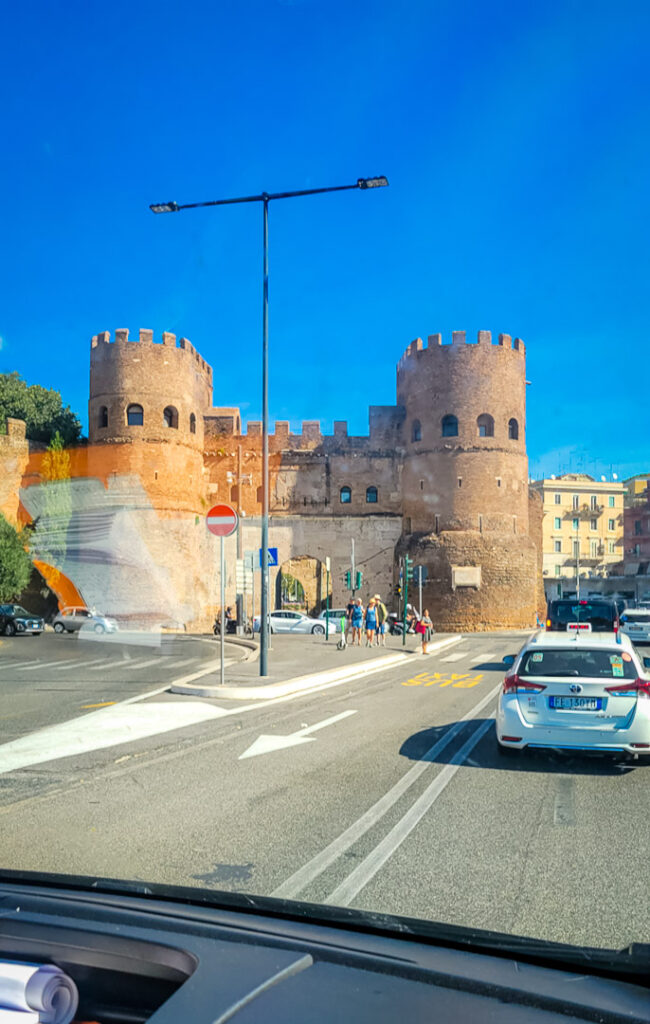

Once we checked in, I was ready to hit the streets. The afternoon sun was perfect, the city was calling, and I had carefully mapped out our must‑see stops. Sadly, not everyone shared my enthusiasm; I knew the others would have been happy to just collapse on the bed and rest. But no. When in Rome, right?
After settling into the room and dropping off our luggage, they begrudgingly agreed to follow my planned itinerary, and our Roman adventure officially began.
Piazza del Popolo
The Taxi Ride to Piazza del Popolo
We crammed into a taxi and headed toward Piazza del Popolo. Most taxi drivers in Rome don’t speak English, so communication becomes a mix of short Italian phrases, hand gestures, and mutual understanding. The ride itself was a real‑life test of patience and reflexes, scooters darting between cars, horns blaring, sirens echoing somewhere in the distance, and our driver muttering a few choice words every time someone cut him off. Good times, indeed.
First Look at Piazza del Popolo
After weaving through the heart of Rome, the piazza finally came into view. Once the main northern gateway into the city, Piazza del Popolo centers around the towering Flaminio Obelisk, an ancient Egyptian monument originally erected at Heliopolis and brought to Rome by Emperor Augustus in 10 BC to decorate the Circus Maximus. It was later moved to its current location in the late 1500s. I had researched this spot beforehand and was genuinely excited to touch a piece of history that predates the Colosseum. But not today.
A Closed Square and a Change of Plans
The entire square was blocked off for what looked like a media event. Between me and that 3,300‑year‑old obelisk stood plastic barricades and several Polizia Locale officers.
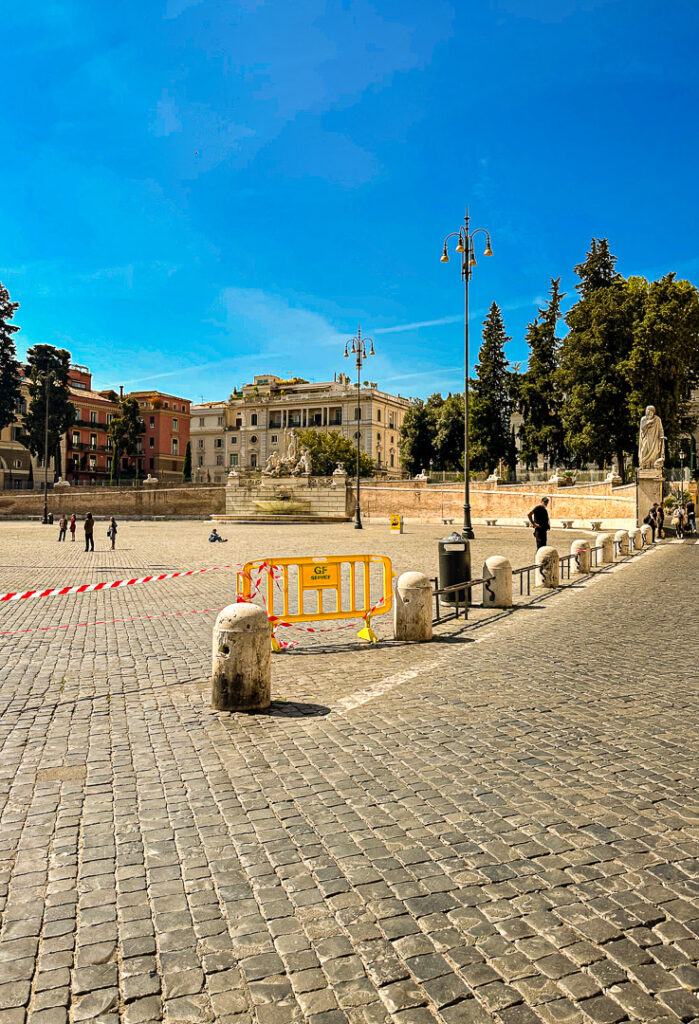
My family gave me the look, the “okay… now what?” look. To them, it was just a tall stone in the sun. I tried explaining its significance, but they were more interested in finding shade. So I sighed, accepted defeat, and pivoted to my next stop. This is where pre‑planning really pays off.
Discovering Santa Maria del Popolo
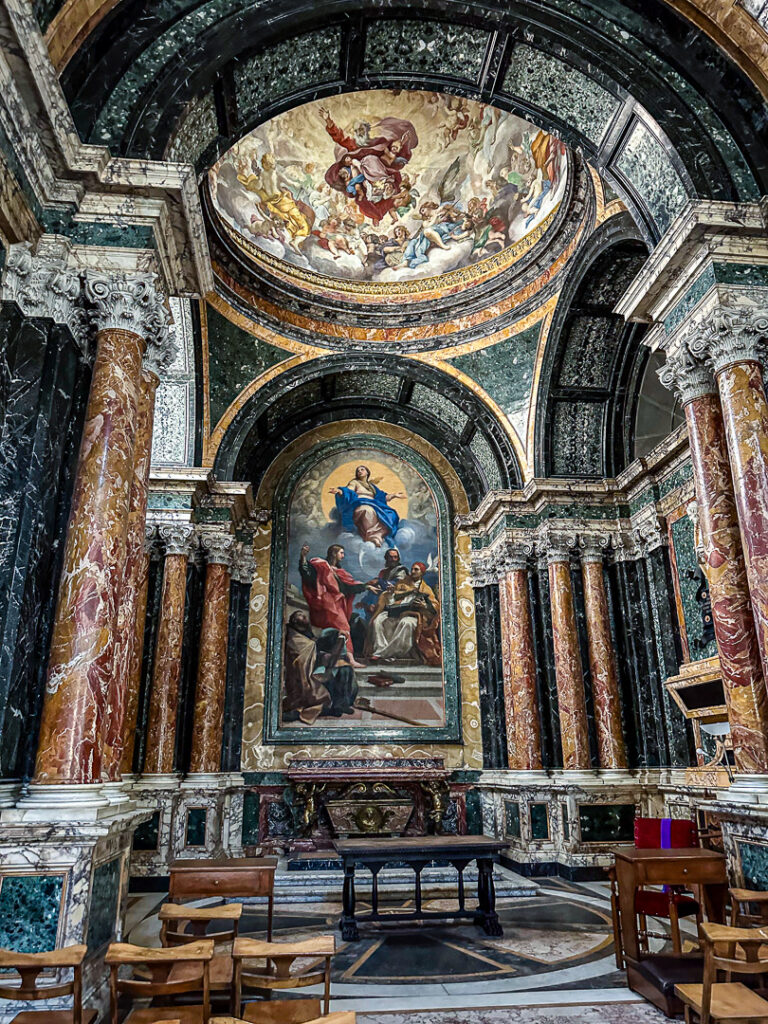
Just off the piazza, tucked quietly in the corner, is Basilica Parrocchiale di Santa Maria del Popolo, easy to miss from the outside, but home to an incredible collection of Renaissance masterpieces. Built on the site where Emperor Nero was supposedly buried, the church features works by Caravaggio, Raphael, Bernini, and Bramante all under one roof.
If you’ve seen Angels & Demons, this is one of the film’s locations. Inside, the noise of the city melted away. The quiet was striking. Each of us wandered off to explore, and I spent the longest time in front of Caravaggio’s Crucifixion of Saint Peter (1600), depicting Peter hung upside down as he requested, not wanting to be martyred in the same way as Christ. Seeing a painting of that magnitude in a neighborhood church instead of a museum was unreal.


Scalinata di Trinità dei Monti (Spanish Steps)
From Piazza del Popolo, we followed Via del Babuino toward Piazza di Spagna, home of the Spanish Steps. This street is considered a gem for shopping, with its designer boutiques, art galleries, and cozy cafes. It felt like we were drawn to every window we passed, especially my aunt the fashionista. After a few minutes of window shopping, we kept moving with the crowd.
You know you’ve arrived when the area opens up with people congregating, then you hear dozens of conversations blending into one steady buzz, along with phone ringers and the occasional street musician.
The Spanish Steps or Scalinata di Trinità dei Monti, as locals call them, are less of a monument and more of a social scene. The nickname “Spanish Steps” comes from Piazza di Spagna, the square at the base of the staircase, which was named after the Spanish Embassy to the Holy See located there in the 17th century.
Over time, English‑speaking visitors began referring to the staircase by the name of the square, and the nickname stuck. Every inch was covered with tourists, just like us, posing for photos, lounging in the sun, or crowding around Bernini’s Fontana della Barcaccia, the “Fountain of the Boat,” at the base.
We wanted to climb to the top, but the afternoon heat said otherwise. Instead, we claimed a shady spot near the fountain and people‑watched for a bit.

Lunch at Osteria al 31
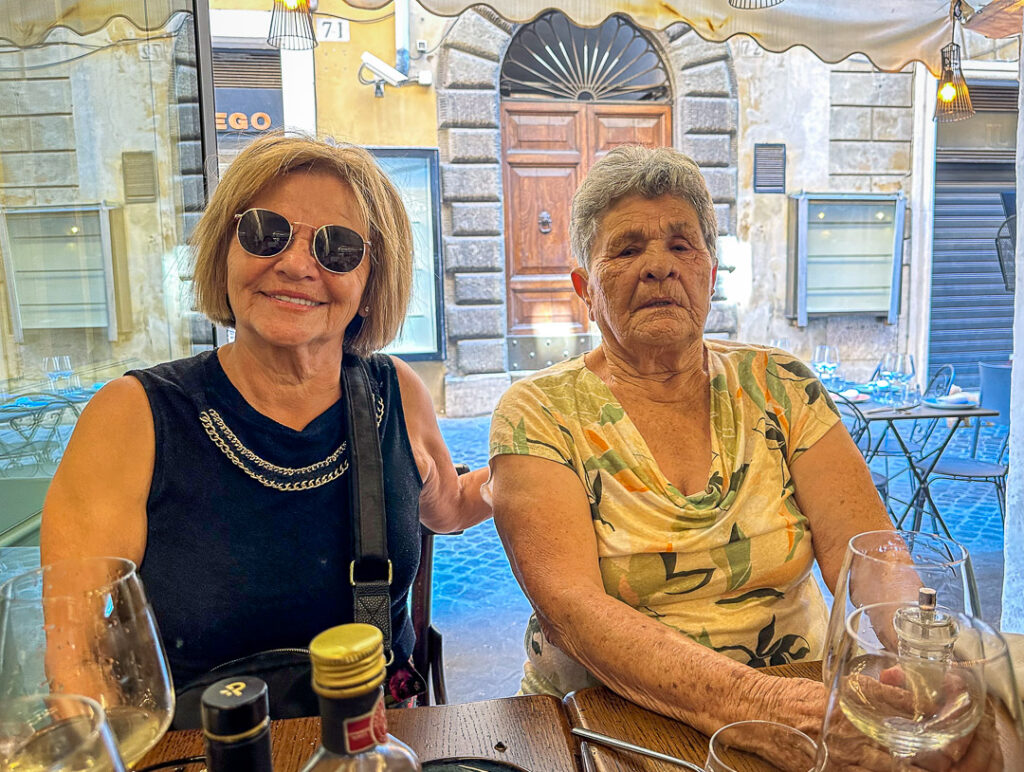
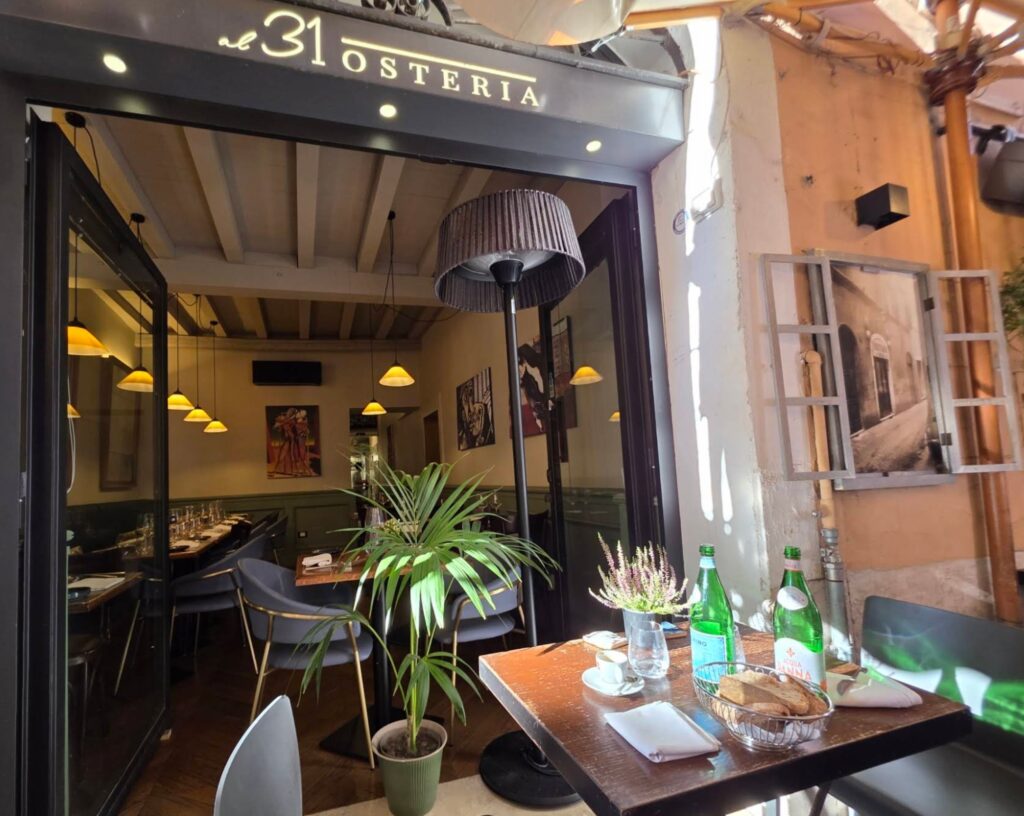
By then, lunch was overdue. Everyone was hitting that dangerous hunger point where making any decision becomes impossible. We ducked down a side street and found Osteria al 31, simple, quiet, and free of the usual “come inside!” hustle. The food wasn’t a standout, but the ambiance was pleasant, and we were grateful to sit down and enjoy our first meal in Rome. While the food wasn’t a culinary highlight, the ambiance was pleasant, and we were simply glad to be sitting down, enjoying the afternoon vibes over our first meal in Rome.
Church of St. Ignatius of Loyola
After finishing the last of the wine in our glasses and delivering my best-practiced, “Conto, per favore,” we strolled to the Church of St. Ignatius of Loyola, a Baroque masterpiece renowned for its illusionist ceiling. The fresco by Andrea Pozzo creates the impression of a soaring dome, but it is actually completely flat, painted with such mathematical precision that it defies belief.
When entering, there is a slanted mirror, perfectly positioned for viewing the ceiling, along with a long line of tourists waiting for their turn to stand beneath it, without looking up. We decided not to wait and were content to tilt our heads back, trying to figure out how they accomplished this in the 1680s without computers, laser measurements, or any modern tools.
It was a brief stop, but the ingenuity and artistry of the church’s ceiling left a lasting impression. I didn’t capture any interior photos, but I did record some footage and later put together a YouTube short: “A Look Inside the Church of St. Ignatius of Loyola.”
Trevi Fountain
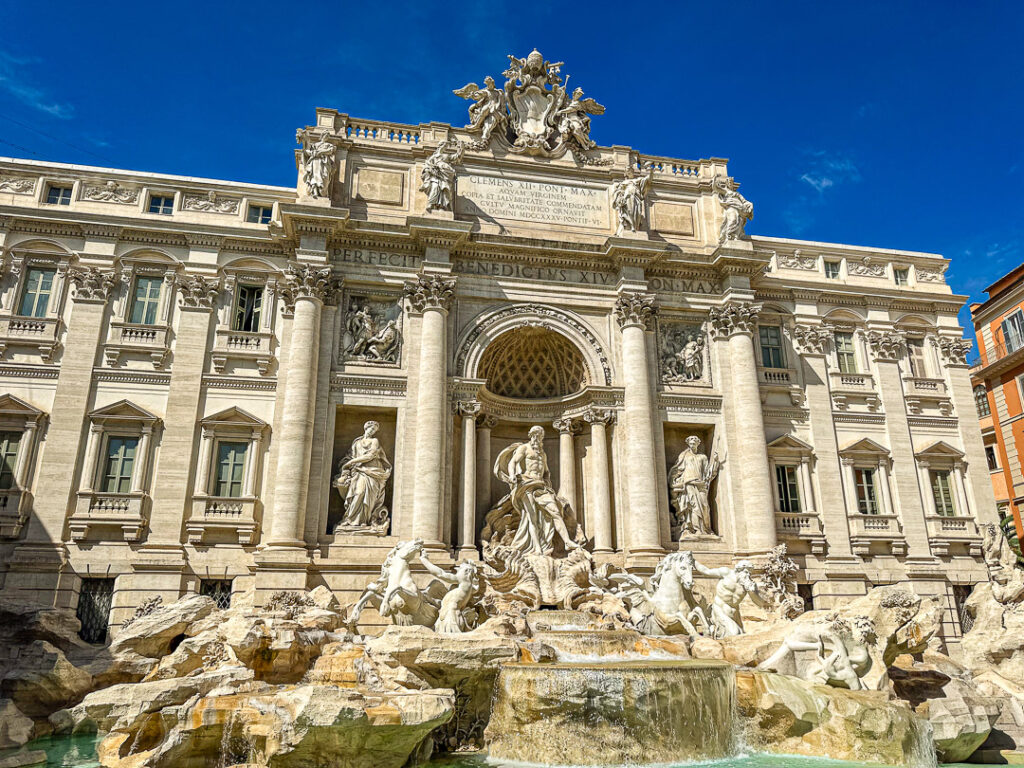
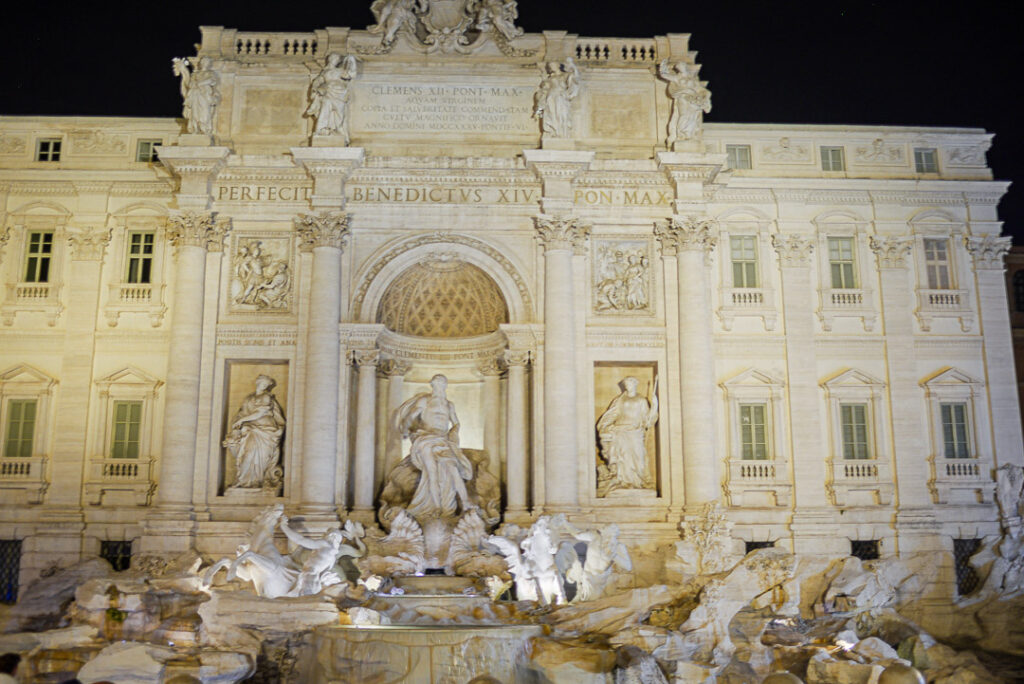
Leaving the stillness of the church, we made our way toward the Trevi Fountain. You hear it before you see it, the rush of water echoing through narrow streets. By late afternoon, the crowds were pure chaos: shoulder‑to‑shoulder tourists, selfie sticks everywhere, tour groups in matching hats, and vendors aggressively pushing roses and bracelets.
One look at the mob and I knew we weren’t fighting through it. Between the crush of people and my paranoia about pickpockets (this area is notorious), my mom and aunt managed to squeeze to the front for a quick photo. After a brief moment of admiration, we kept moving.
The Pantheon: Rome’s Architectural Masterpiece
Arriving at Piazza della Rotonda
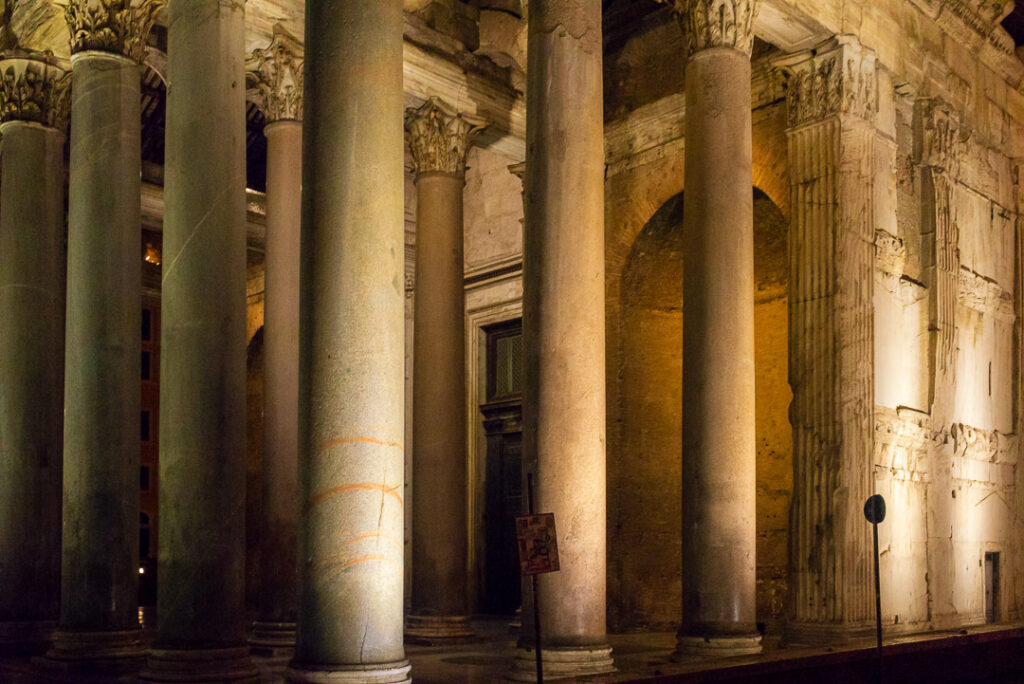
Within minutes of leaving the Trevi Fountain, we reached Piazza della Rotonda, home to the Pantheon. At the center of the square stands the Fontana del Pantheon, a 16th‑century fountain later redesigned in 1711 to incorporate the ancient Egyptian Obelisk Macuteo, a monument dating back to the reign of Ramses II. It’s one of those moments where Rome casually places 3,000‑year‑old history in the middle of a lively piazza.
Stepping Through the Ancient Doors
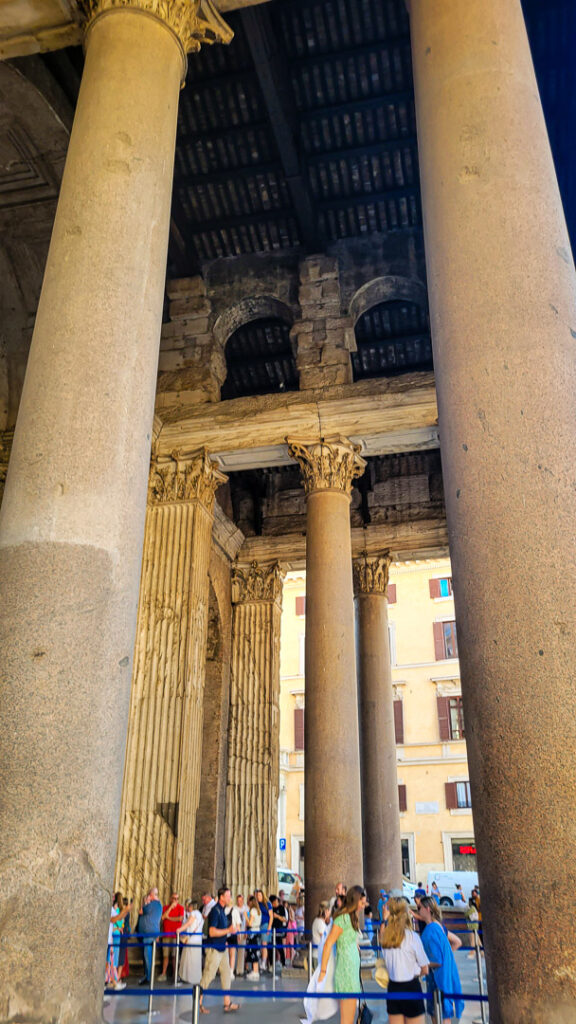
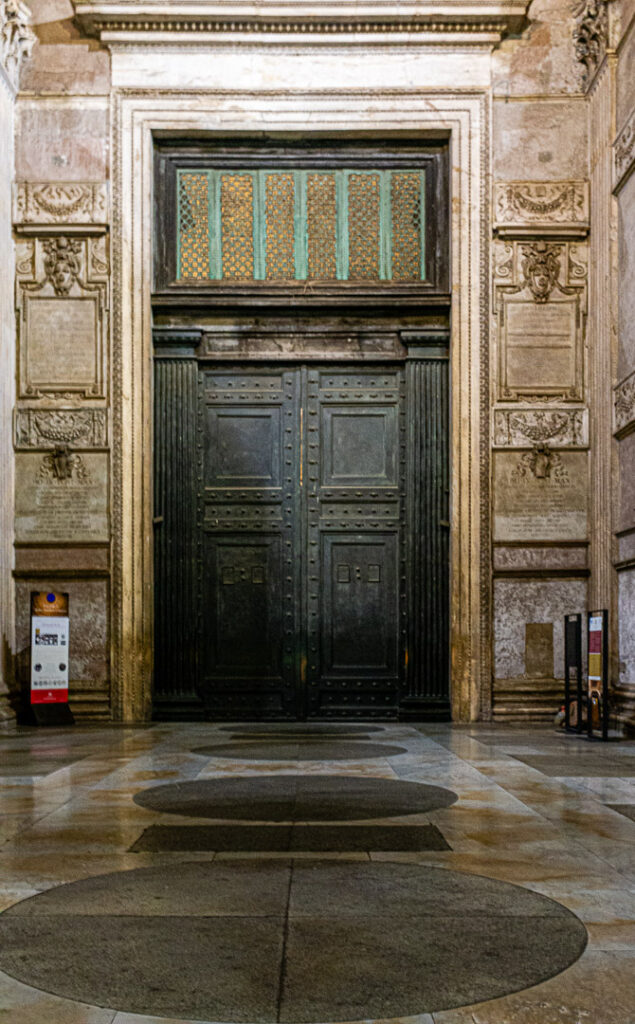
After paying five euros, we entered through the massive 25‑foot‑tall bronze doors, original to the building and dating to around 115 AD. The fact that they still swing open today is a quiet flex of Roman engineering.
Inside the Pantheon
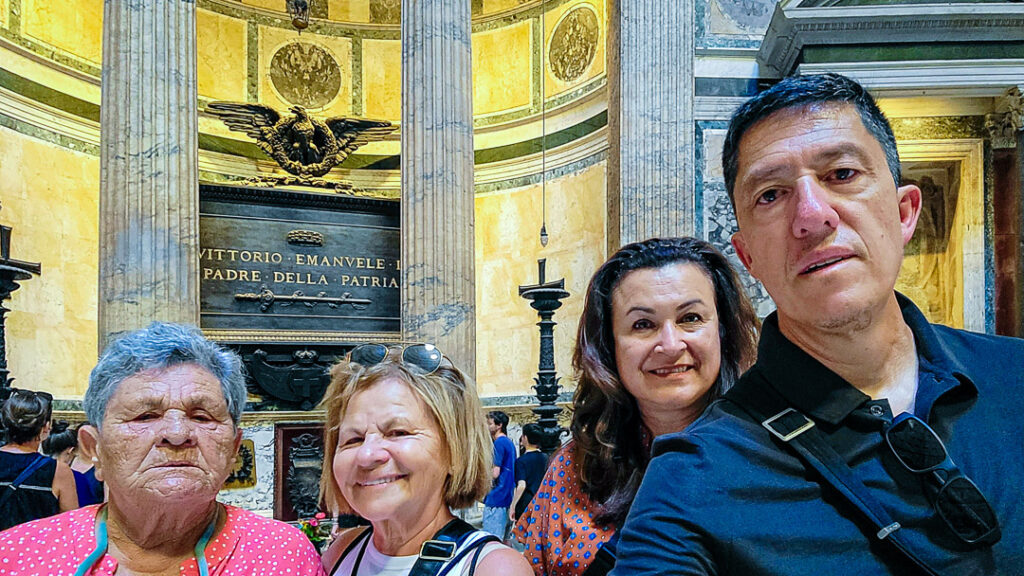
Inside, the Pantheon is breathtaking. Even with the crowds, the oculus steals the show, a perfect circle of light that drifts across the interior like a spotlight from the gods. But the real marvel is the dome itself. Built nearly 2,000 years ago, it remains the world’s largest unreinforced concrete dome, a feat the Romans achieved long before modern machinery.
How the Dome Stays Standing
The dome is a masterpiece of ancient engineering. Its height and diameter are identical, forming a perfect sphere that would fit inside the rotunda. To reduce weight, the Romans used concrete that becomes progressively lighter as it rises, dense stone at the base, shifting to pumice near the oculus.
The dome’s coffers, arranged in five concentric rings, aren’t just decorative. They remove massive weight while creating a rhythmic pattern that pulls your eyes upward. Their precision is so remarkable that modern architects still study how they were laid out on the curved surface.
Standing beneath the dome, you feel the scale of what the Romans achieved. No steel. No rebar. Just ancient concrete, geometry, and ambition.
When to Visit the Pantheon
The time of day makes a big difference, so go early or late if you can. Our visit landed right in the midday rush, and with little crowd control, it was tough to slow down and really absorb the space, yet somehow still unforgettable. After taking in the atmosphere as best we could, we lingered a bit longer than planned before wandering back toward the hotel, grabbing gelato along the way, and finally settling in for some much‑needed rest before dinner.
If you want a real‑time look at the atmosphere, check out my video: Inside the Pantheon.
Dinner at Ai Tre Scalini
To wrap up our first night in Rome, we headed to Ai Tre Scalini in the Monti district. I had researched this place extensively, and it didn’t disappoint. The wine bar has been around since the late 1800s and still feels like a local secret, tucked away on a side street you’d never stumble upon by accident.
The place was packed with Romans unwinding after work, the air filled with conversation and the clinking of plates and glasses. We squeezed into a corner table and laughed about the slightly cramped setup, but it added to the authentic neighborhood feel. Dinner was delicious, and we appreciated the complimentary limoncello, a tradition we later learned is how Romans like to finish their meals.
After some wine and pasta, we walked back to the hotel as the city shifted into night mode. Streetlights painted the cobblestones gold, restaurants were just getting busy (Romans eat late), and the temperature had dropped to perfect walking weather. We were exhausted, full, and completely enchanted.
Colosseum and The Roman Forum
The next morning started early, and as much as I wanted to hit snooze, there was no time. We had a private Colosseum tour scheduled for 9 a.m., so after breakfast we set out on foot. A few zigzags through side streets brought us to Via dei Fori Imperiali, the grand avenue Mussolini built in the 1930s to showcase Rome’s ancient glory. The road connects Piazza Venezia to the Colosseum and is lined with the ruins of the Imperial Forums, a dramatic approach if there ever was one.
First Glimpse of the Colosseum
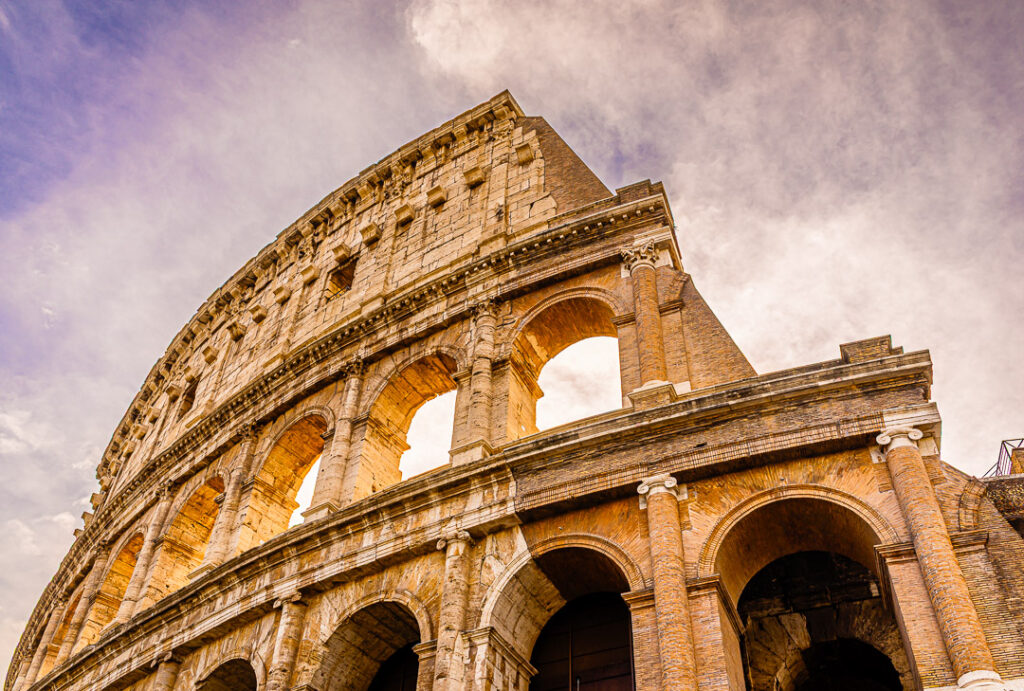
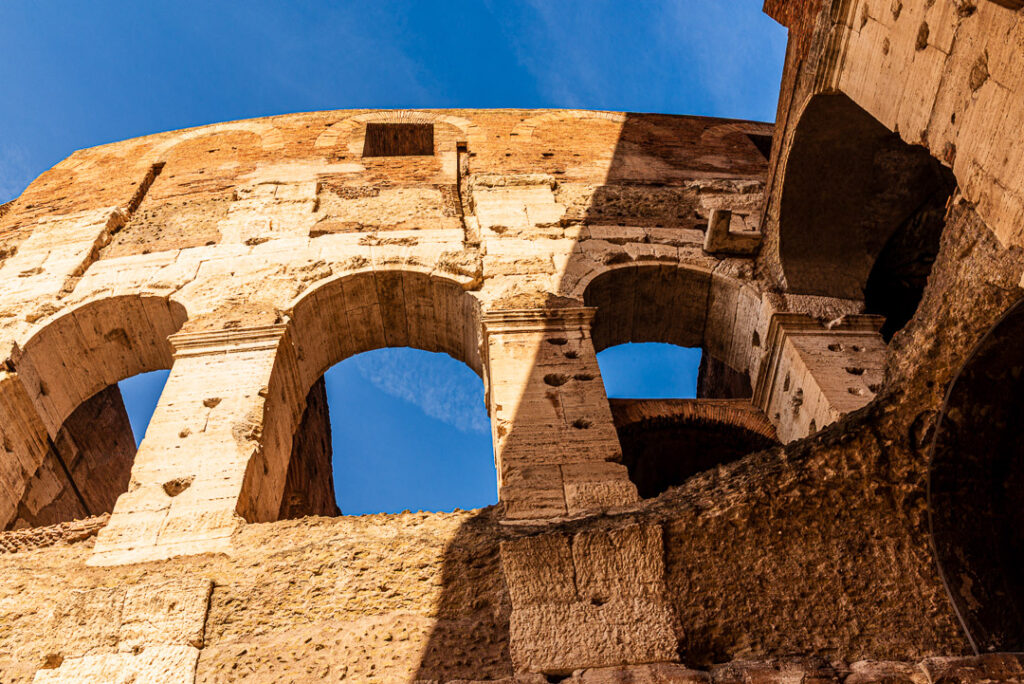
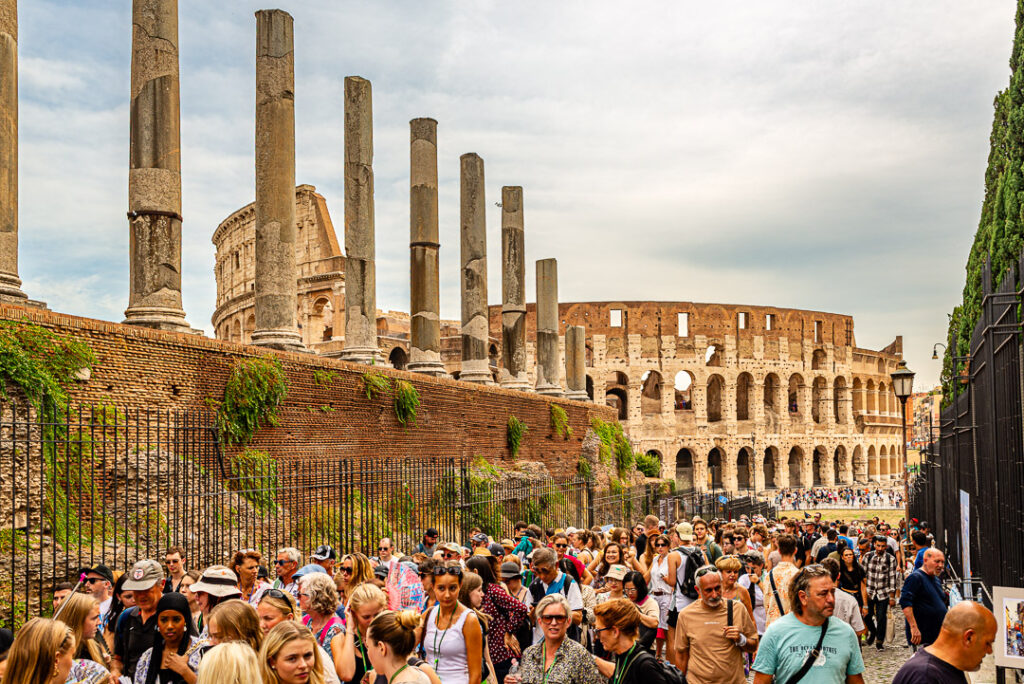
As the Colosseum came into view, we all smiled. No matter how many photos you’ve seen, nothing prepares you for the scale of it. Even after centuries of earthquakes, fires, and dismantling, the Colosseum remains massive and awe‑inspiring. Having now experienced it firsthand, I understand why more than 15 million people visited in 2024.
Meeting Our Guide
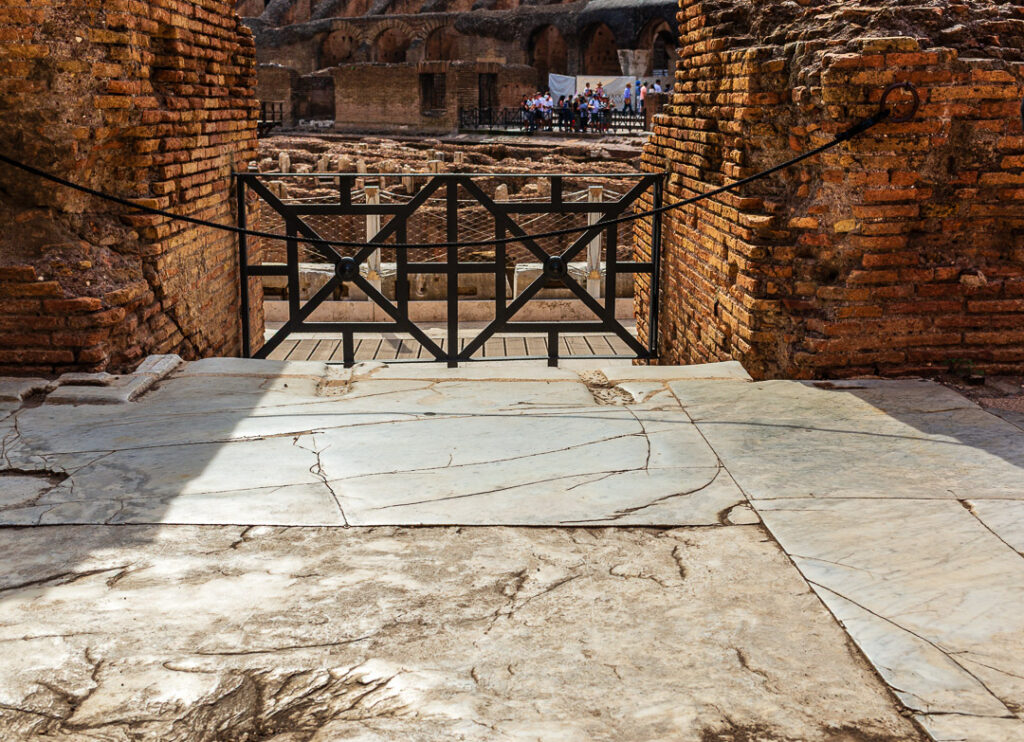
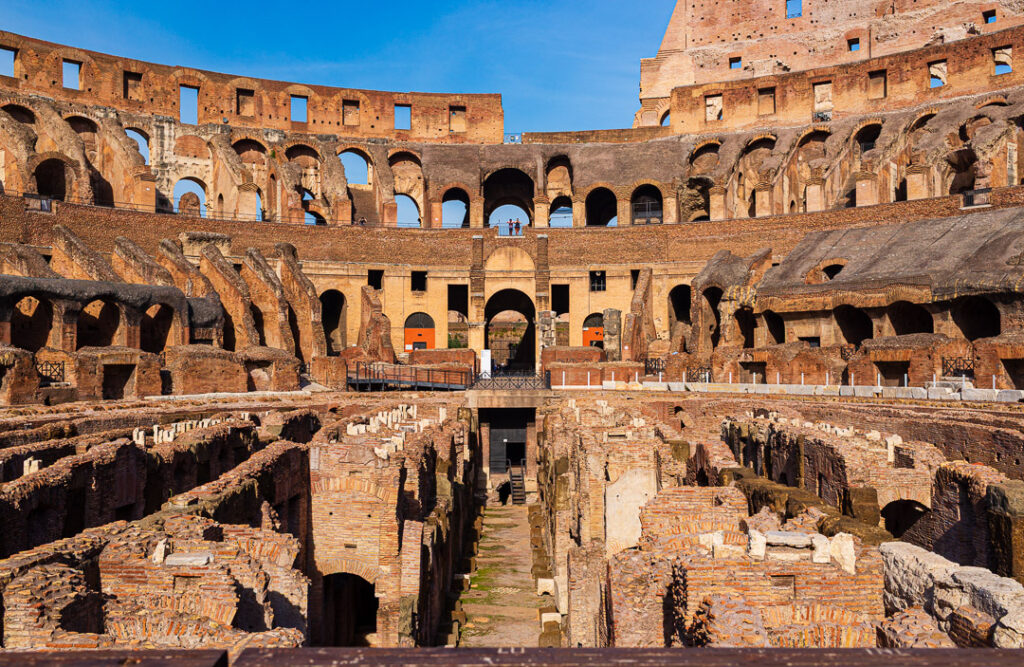
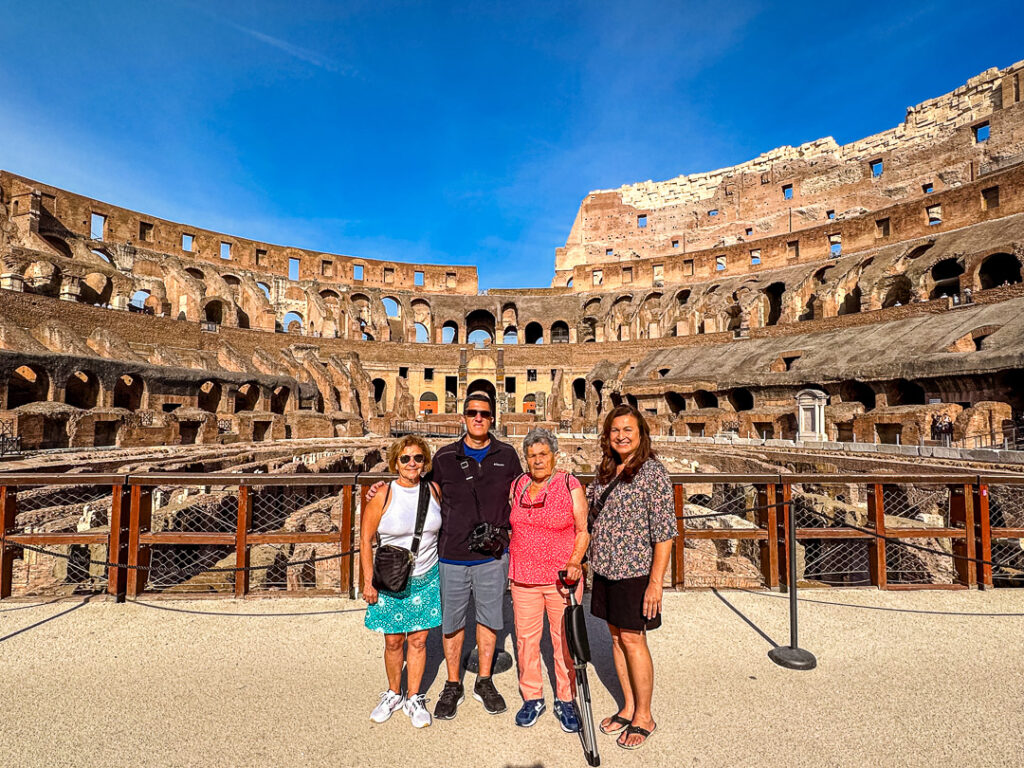
We met our guide, Laura, in front of the metro station and made our way to the entrance. Originally, our tour was supposed to include the underground hypogeum, but two months before the trip we received an email saying that portion had been canceled. A letdown, yes, but standing on the platform and looking out over the arena still exceeded expectations.
Inside the Colosseum
Our Liv Tours guide was fantastic, knowledgeable, passionate, and unmistakably Roman. She explained how the Colosseum was built in the 1st century AD under Emperor Vespasian and completed by his son Titus in 80 AD. Inside, she pointed out the engineering marvels: massive travertine arches held together without mortar, numbered entrances that allowed 50,000 spectators to enter and exit efficiently, and the hypogeum below, a maze of tunnels and lifts once used to send animals and gladiators into the arena for dramatic appearances… and for some, their final moments.
My favorite detail was the royal and senator seating, the white marble sections reserved for the emperor and Rome’s elite. Perfectly positioned, of course, for the best view in the house.



The Roman Forum
Before this trip, I struggled to understand what the Roman Forum actually was. A single building? A cluster of ruins? A whole neighborhood? And where exactly was it, would I need a taxi to get there?
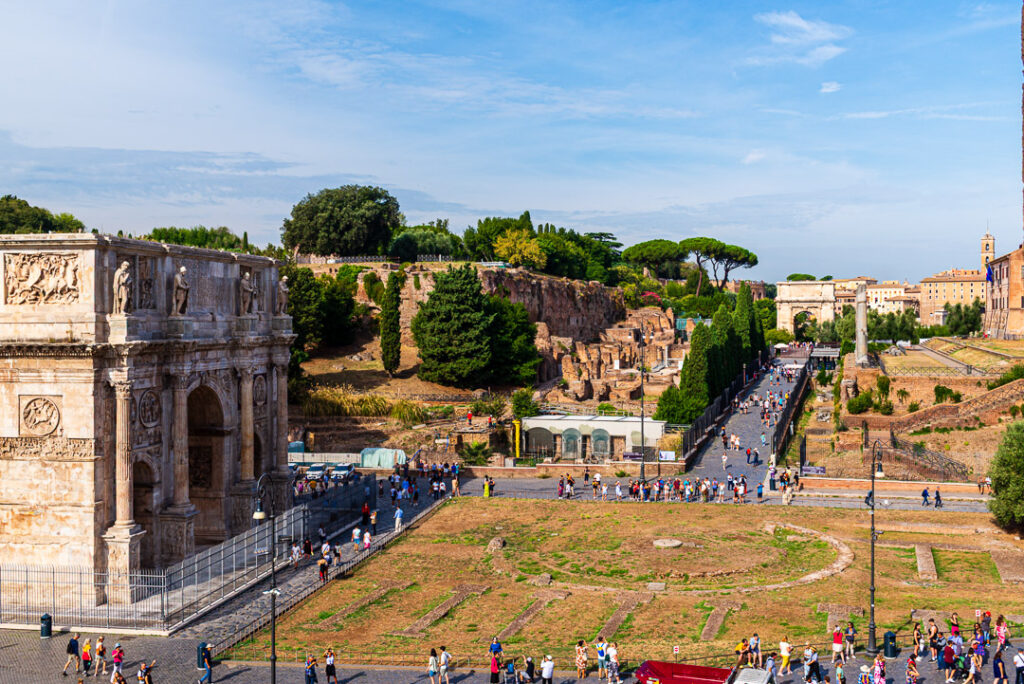
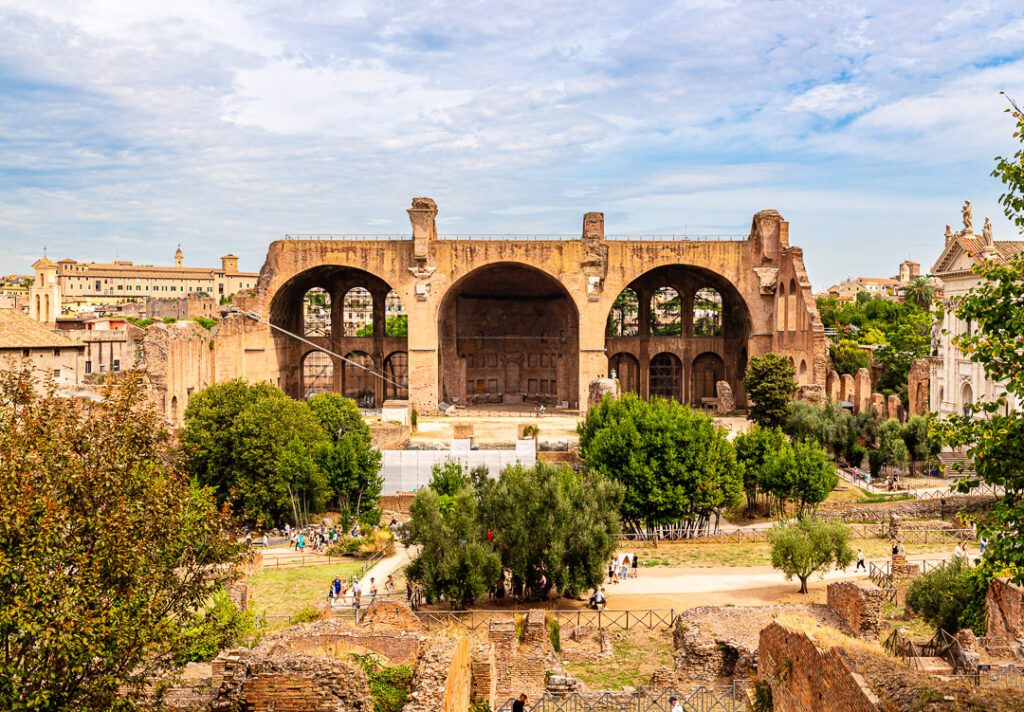
It wasn’t until we stepped out of the Colosseum that it finally clicked. The Forum is right there, sprawling below the arches, the beating heart of ancient Rome laid out like an archaeological map. Seeing it in person suddenly made sense of every diagram, documentary, and guidebook description I’d ever skimmed.
A Brief History of the Forum
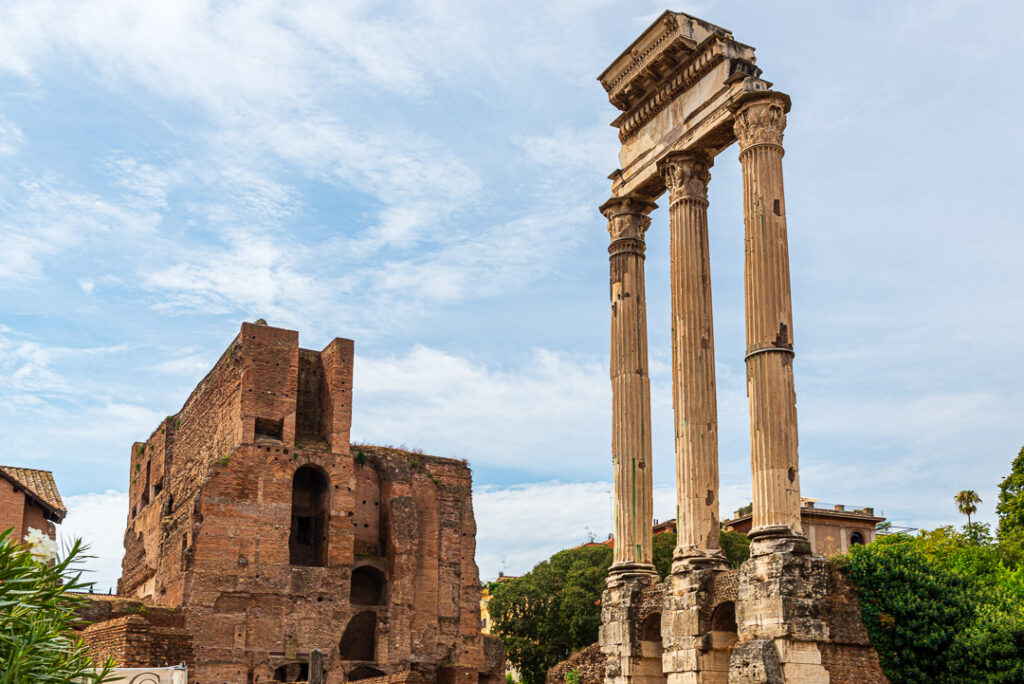
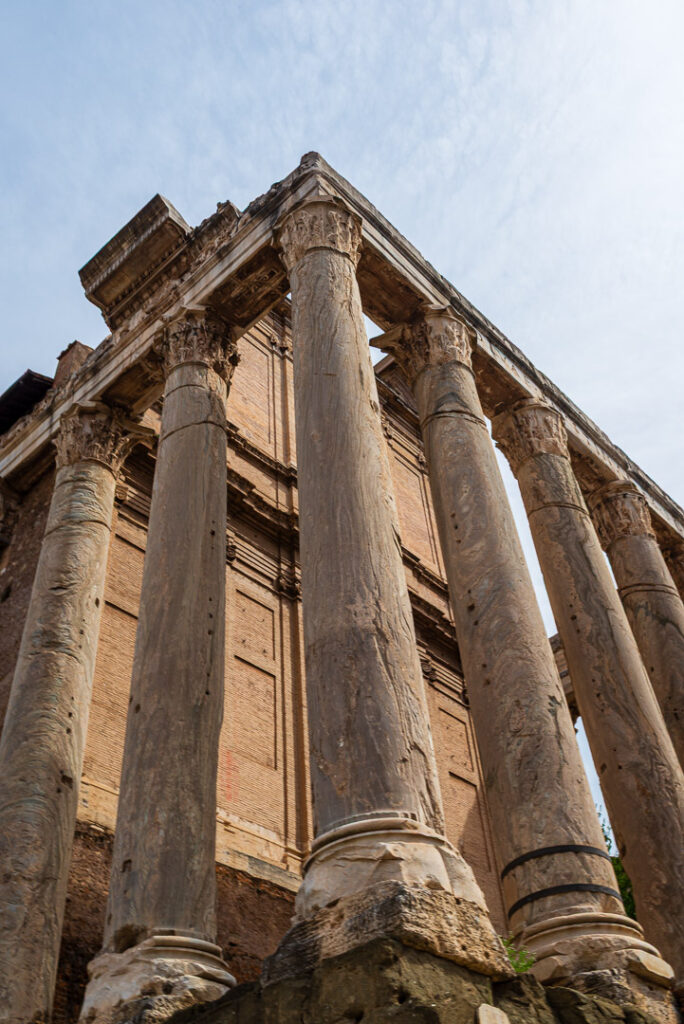
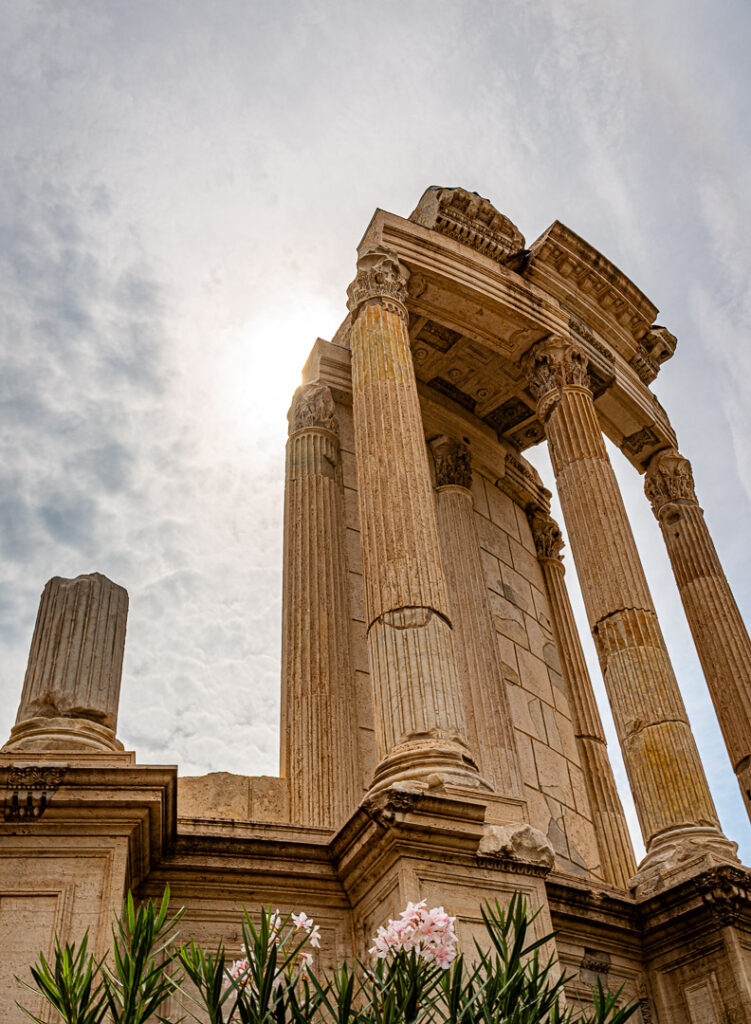
A quick history primer: The Forum began as a swamp between two hills before early Romans drained it in the 7th century BC. Over time, it evolved into the center of Roman life, markets, temples, court hearings, political speeches, triumphal processions.
Julius Caesar and Augustus later added major buildings and monuments, including basilicas, temples, and triumphal arches that reshaped the skyline of ancient Rome.
The Arch of Titus
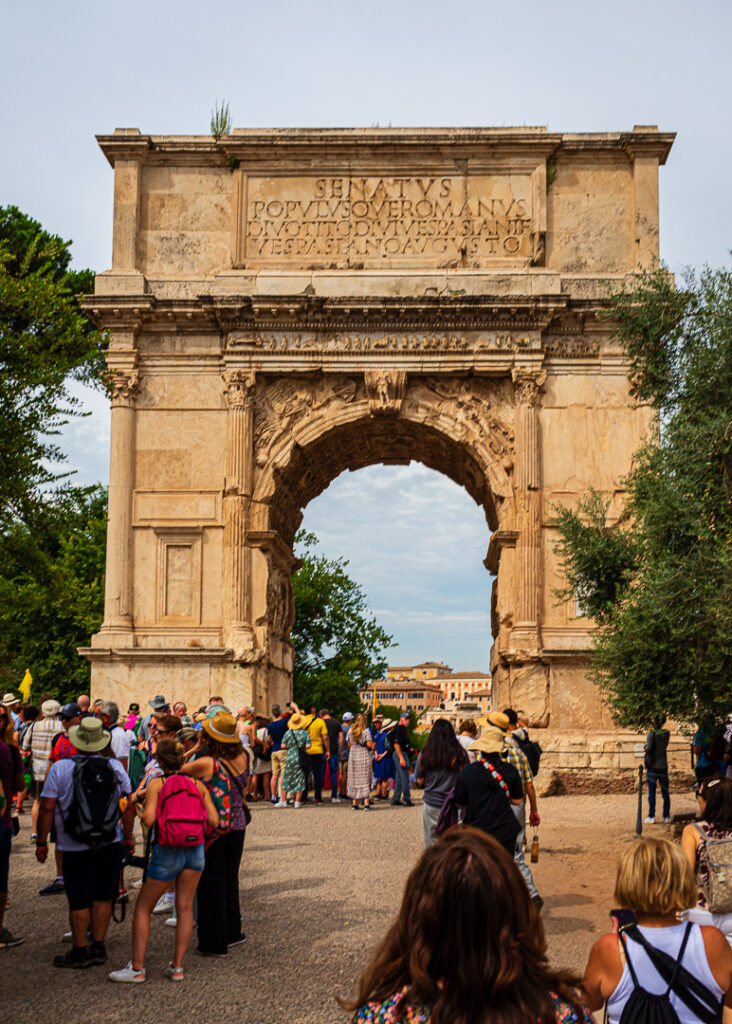
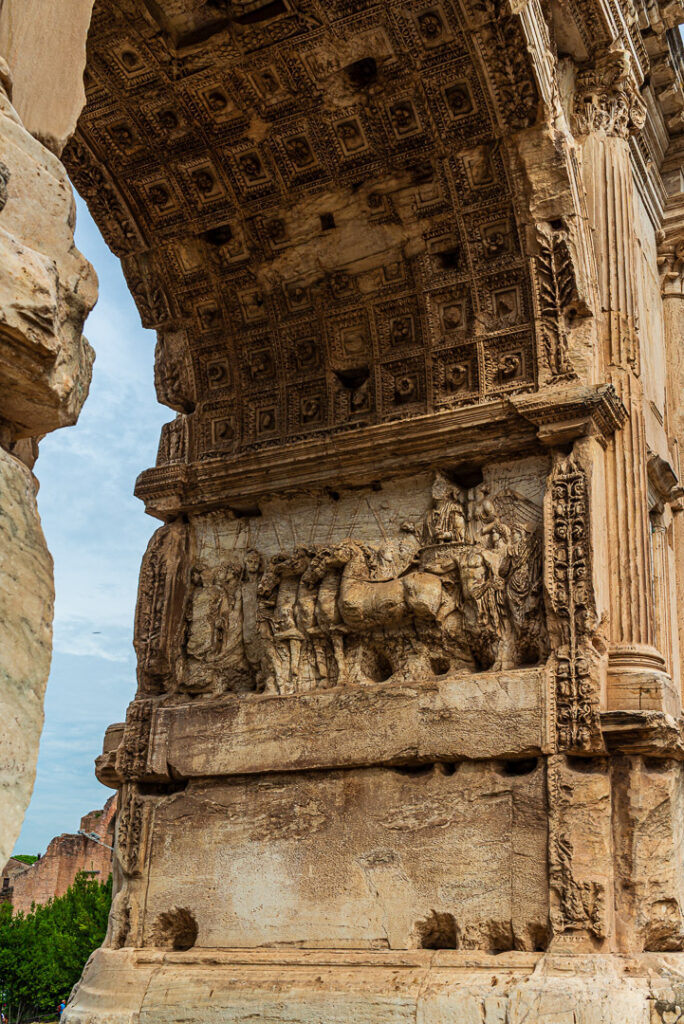
The most famous of these monuments is the Arch of Titus, which depicts Roman soldiers carrying treasures taken from Jerusalem after the city’s destruction, including the menorah and other sacred items. It’s one thing to read about this moment in history, and another to stand beneath the arch and see it carved in stone nearly 2,000 years later.
Just up the hill is the Mamertine Prison, where tradition says the Apostle Paul was held before his execution under Nero. It’s a small, unassuming site, but the weight of its history is unmistakable.
Burial, Rediscovery & Excavation
After the fall of the empire, the Forum was abandoned and gradually buried under centuries of debris. By the Middle Ages, it was little more than a cow pasture, literally known as the Campo Vaccino, the “Field of Cows.” When excavations began in the 1800s, archaeologists uncovered layer after layer of ancient Rome, much of it remarkably preserved thanks to its long burial.
Walking through it today feels like stepping into a time capsule, a rare place where the ancient world still feels close enough to touch.




Lunch at Antico Falcone: The Neighborhood Gem
After wrapping up our Colosseum tour, we grabbed a cab and headed to Antico Falcone, a spot I’d researched before the trip. With its 4.5-star rating and reputation for authentic, home-cooked Roman dishes, I knew it was worth the detour. Tucked away in the Trionfale district just north of central Rome, it’s definitely off the main tourist trail, but that’s exactly what makes it special.
The cab driver seemed surprised when we gave him the address. “Turisti?” he asked, raising an eyebrow. When we nodded, he smiled and said something in Italian that I’m pretty sure translated to “good choice.”
The restaurant was everything I’d hoped for: a no-frills, family-run spot without a trace of pretension. The kind of place where locals actually eat.
We started with cacio e pepe and carbonara, both deceptively simple but incredibly flavorful. After that, the staff asked if we wanted more and said they’d surprise us. They did, in the best way. We also tried Carciofo alla Giudia, the classic fried Roman artichoke. A memorable meal, made even better by sharing it with the people I love most.
This place deserves every bit of its reputation.
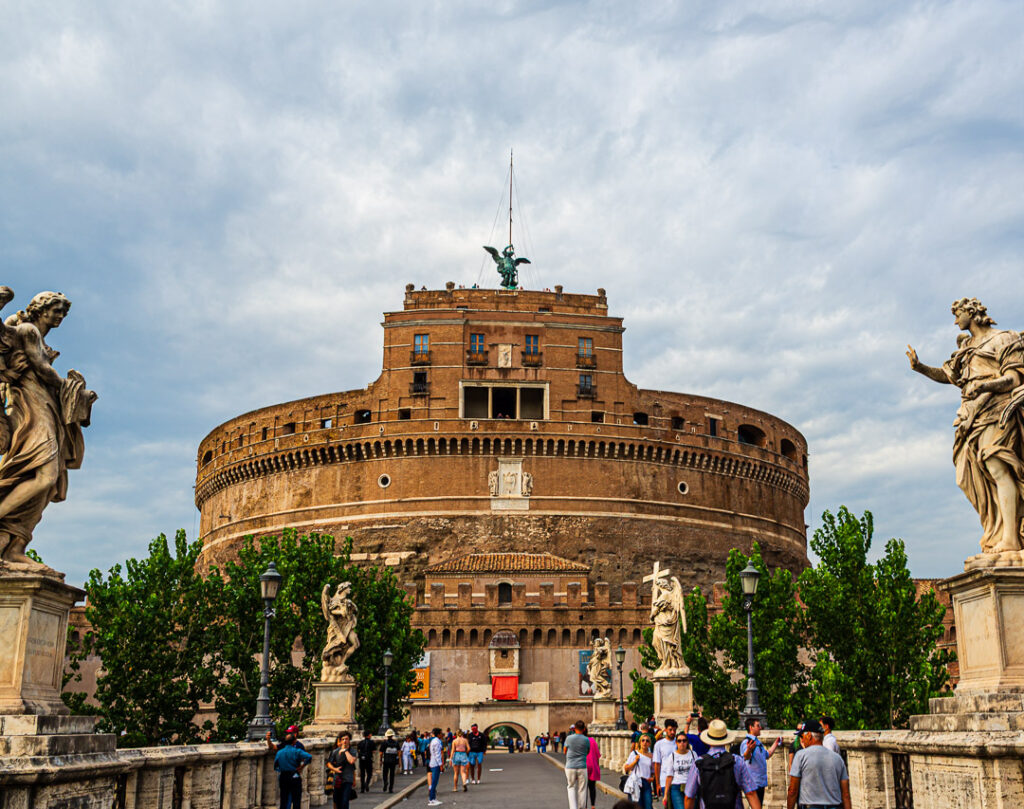
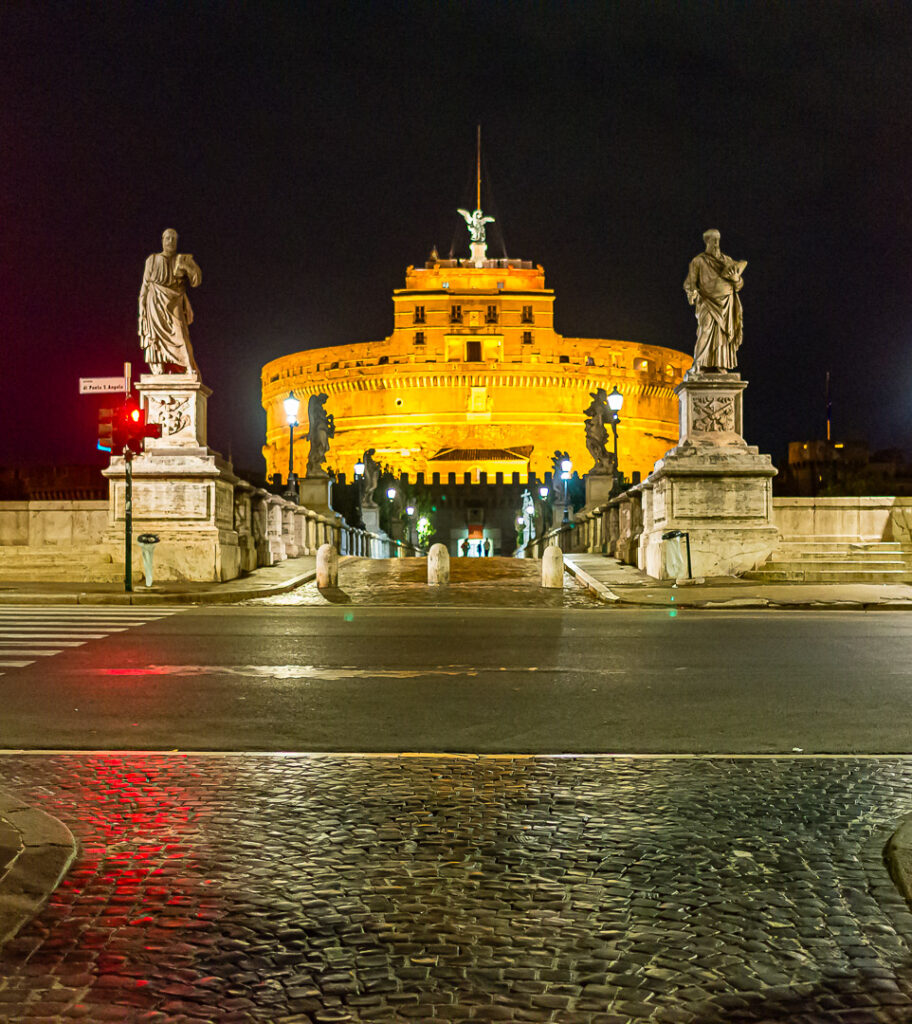
Castel Sant’Angelo: From Tomb to Fortress
After lunch, I would’ve preferred to walk the 1.3 miles to Castel Sant’Angelo, but everyone else was like, “Nah, not happening.” A few taps on the FreeNow app and a short wait later, we were on our way to Castel Sant’Angelo.
First Impressions of the Fortress
Castel Sant’Angelo is a massive cylindrical fortress on the Tiber, originally built by Emperor Hadrian in the 2nd century AD as his mausoleum. Entering it feels like stepping into a vertical timeline of Roman history. The path begins at the base, where thick stone walls and narrow corridors still hint at its origins as Hadrian’s tomb.
Climbing Through the Centuries
A long, spiraling ramp winds upward through the core, once used for funeral processions, later for soldiers and supplies when the structure was converted into a fortress. As you climb, each level reveals a new chapter in its story: ancient burial chambers, medieval armories, and finally the Renaissance‑era papal apartments.
Inside the Papal Apartments
Popes Nicholas V and Paul III once used these rooms as a refuge during sieges, and their influence still shows. The Sala Paolina, named for Paul III, is the highlight, covered floor to ceiling in frescoes of St. Paul framed in gold and vivid color. Nearby, the papal library is smaller but just as ornate, with painted ceilings, carved woodwork, and soft light filtering through narrow windows that catch on the faded murals.
Terraces, Angels, and Panoramic Views
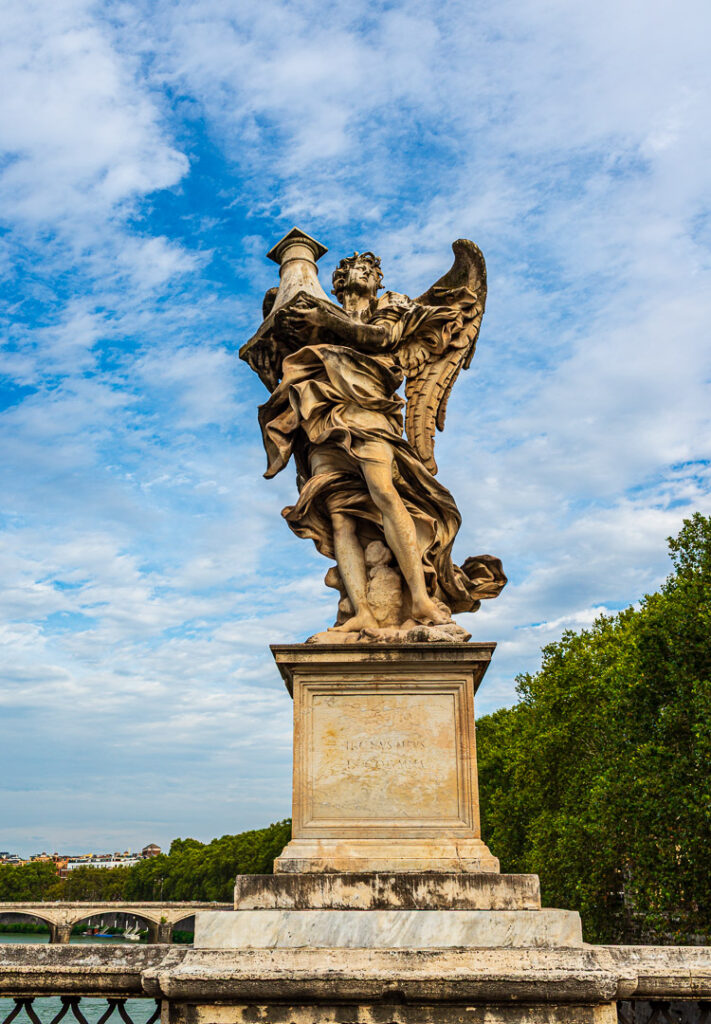
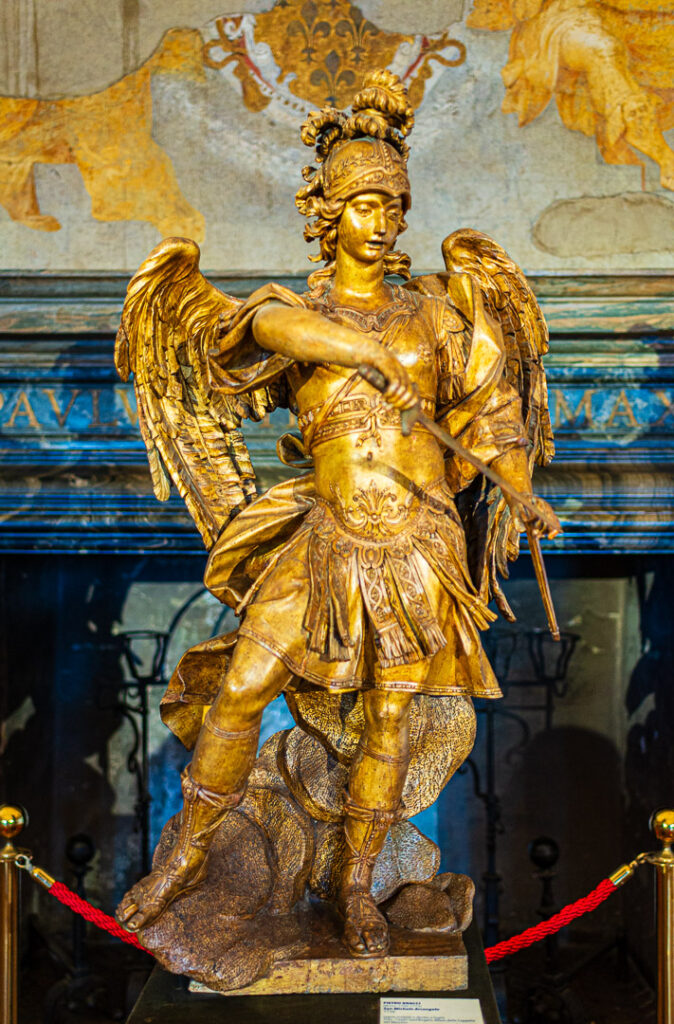
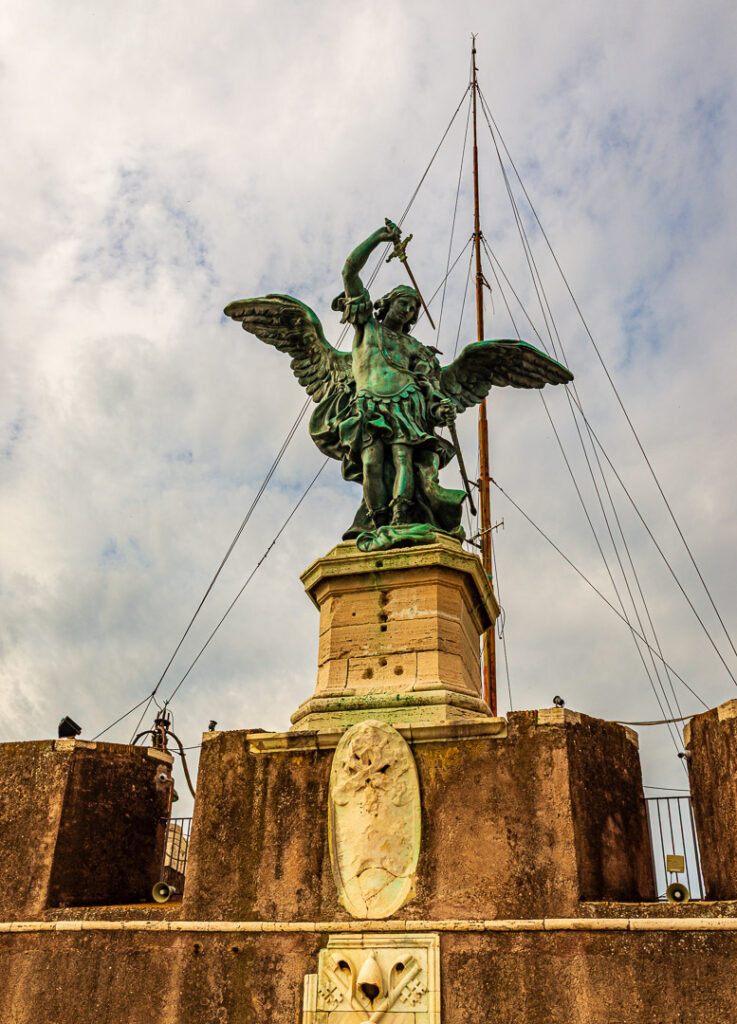
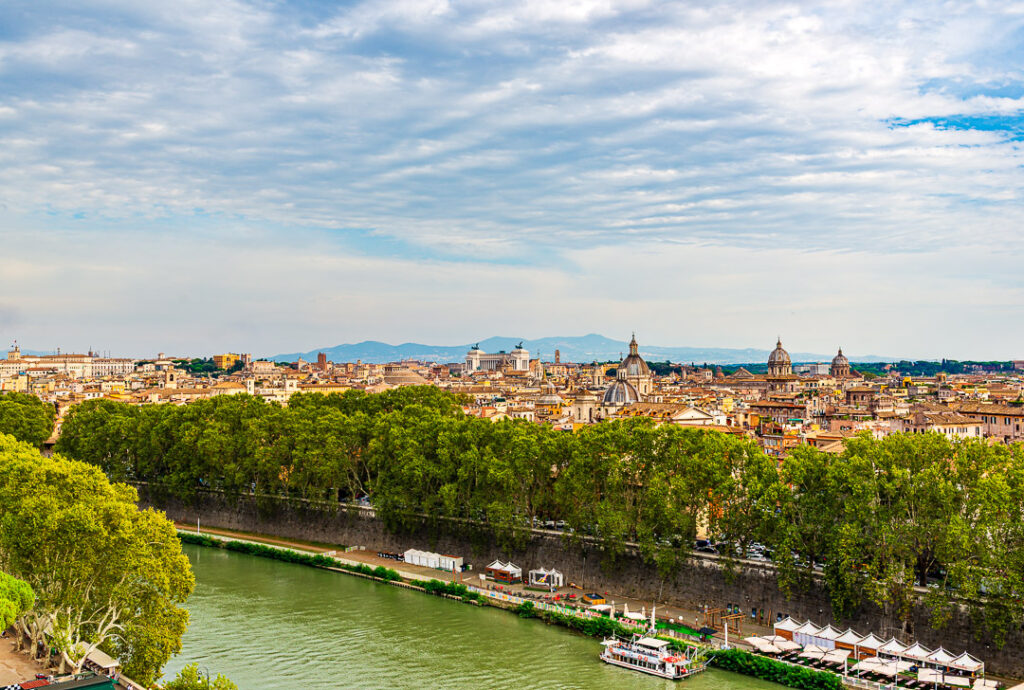
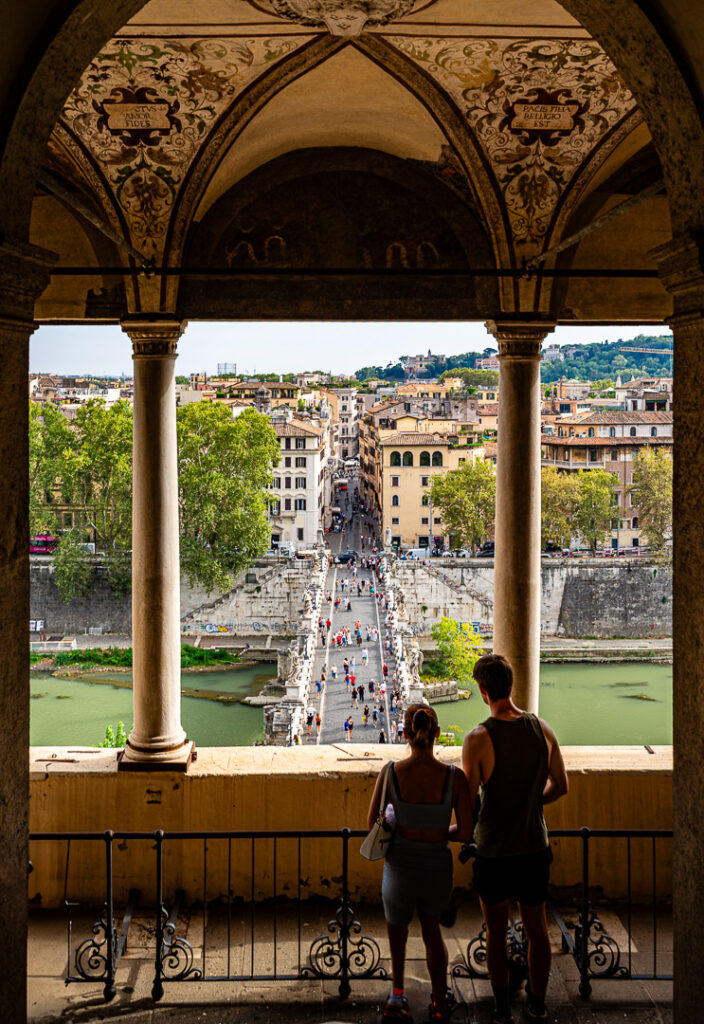
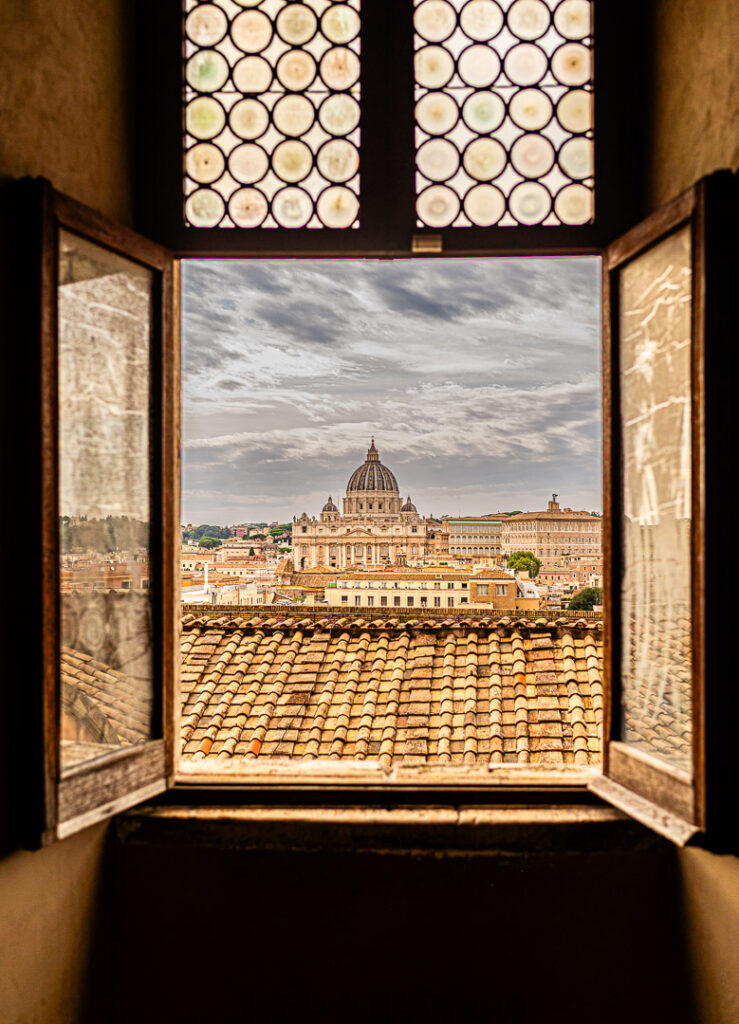
Higher up, the fortress opens onto terraces once used for defense, leading to the statue of the Archangel Michael, the figure that gave the castle its name. At the top, the panoramic view stretches across the Tiber, St. Peter’s Basilica, and the skyline of Rome — a reminder that this single structure has watched over the city for nearly two thousand years.
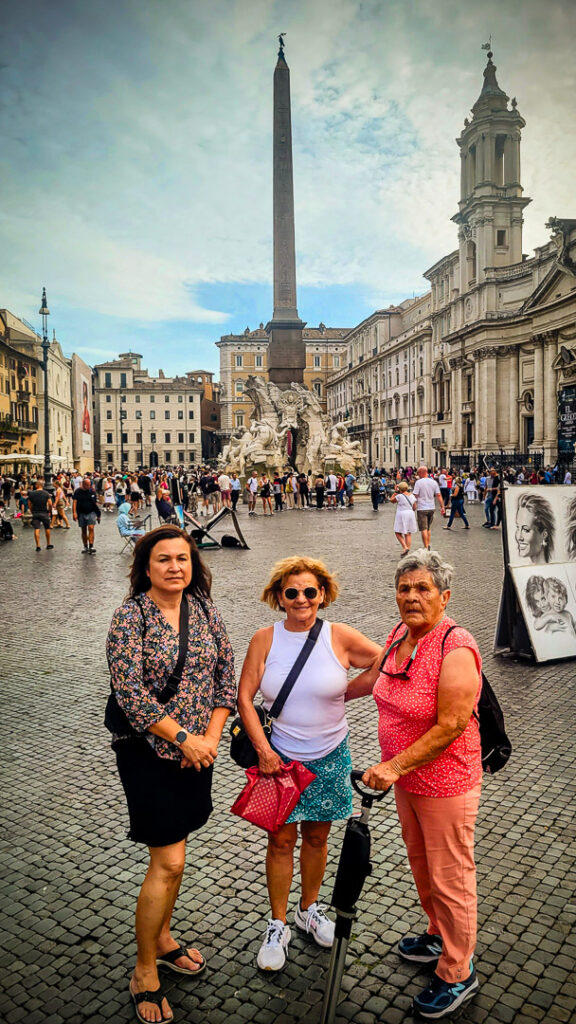
Wrapping up our day, we crossed the Ponte Sant’Angelo and made our way to Piazza Navona for a few last photos. By then we were worn out, so we grabbed a taxi back to the hotel to finally rest after a long day of exploring.


Morning Vatican Tour
Early Start at the Vatican
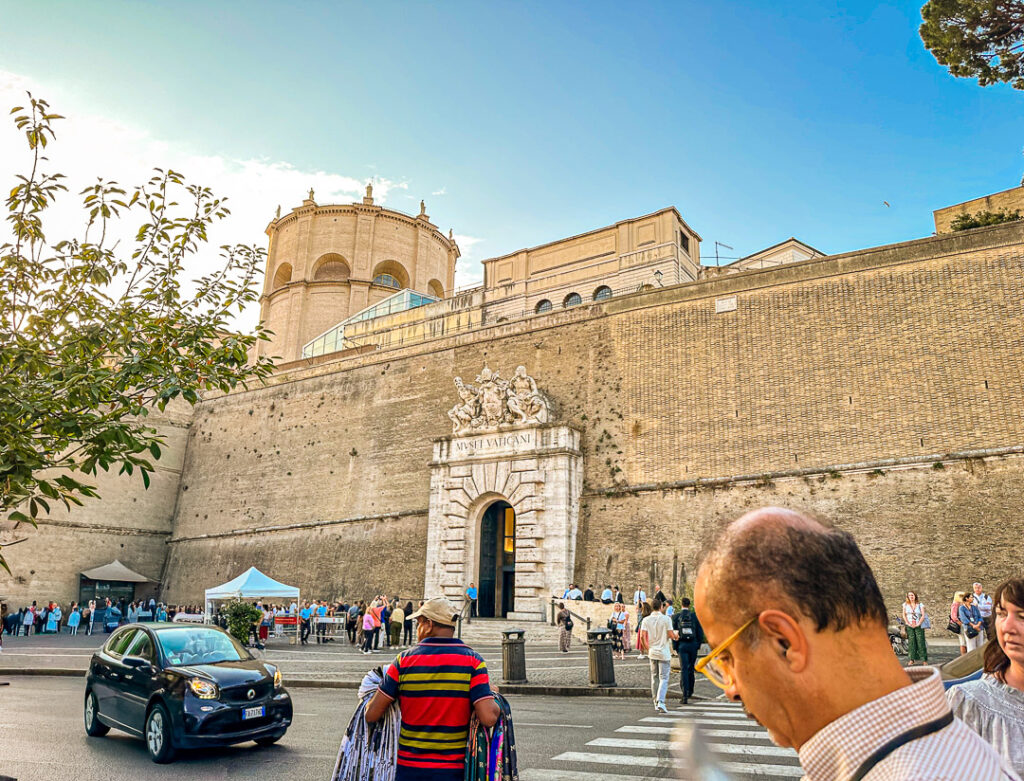
Our final morning in Rome started at 6 a.m. with another Liv Tour, this time a semi‑private Vatican experience covering the highlights: the Vatican Museums, the Sistine Chapel, and St. Peter’s Basilica. “Semi‑private” sounded intimate, but with eight people including the guide, it still felt crowded.
Arriving to an Already Busy Vatican
On the way there, I pictured a calm early‑morning entry, maybe even a relaxed meet‑and‑greet with our guide. Yeah… no. With around 7 million visitors passing through the Vatican Museums each year, even dawn doesn’t guarantee breathing room. The area was already buzzing with tour groups, lines, and the unmistakable hum of a major world attraction waking up.
Our guide was efficient and skilled at navigating the crowds, but her delivery felt more like a schoolteacher checking boxes than someone genuinely excited to share Vatican treasures. Still, she kept us moving through the maze of galleries.
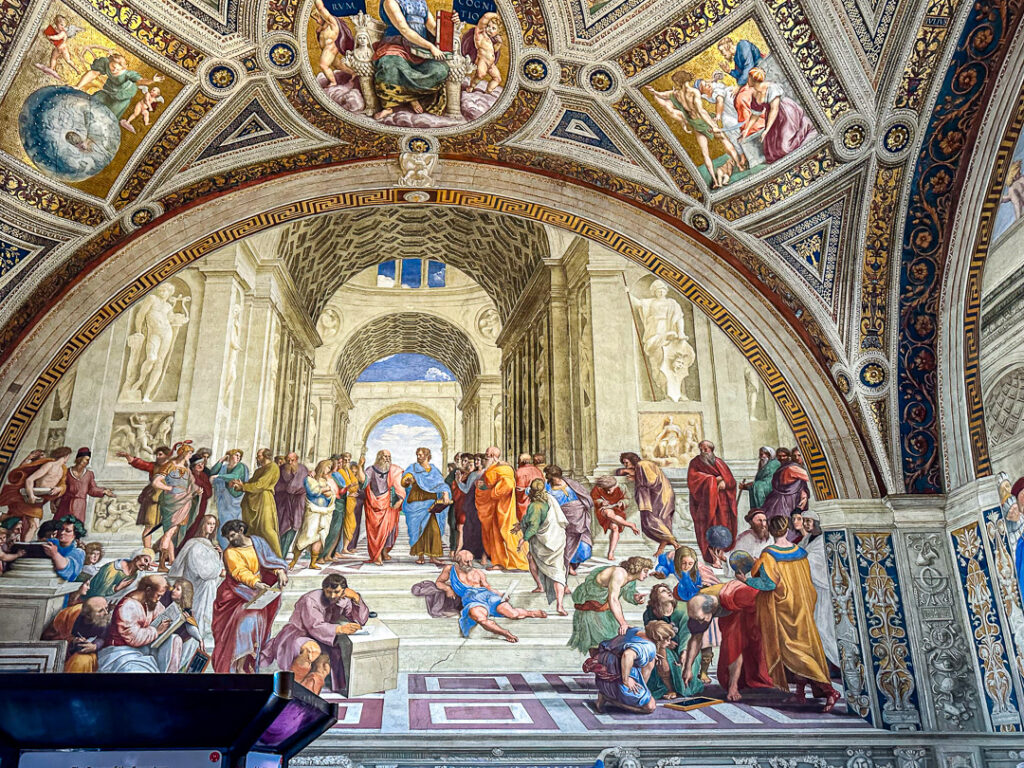
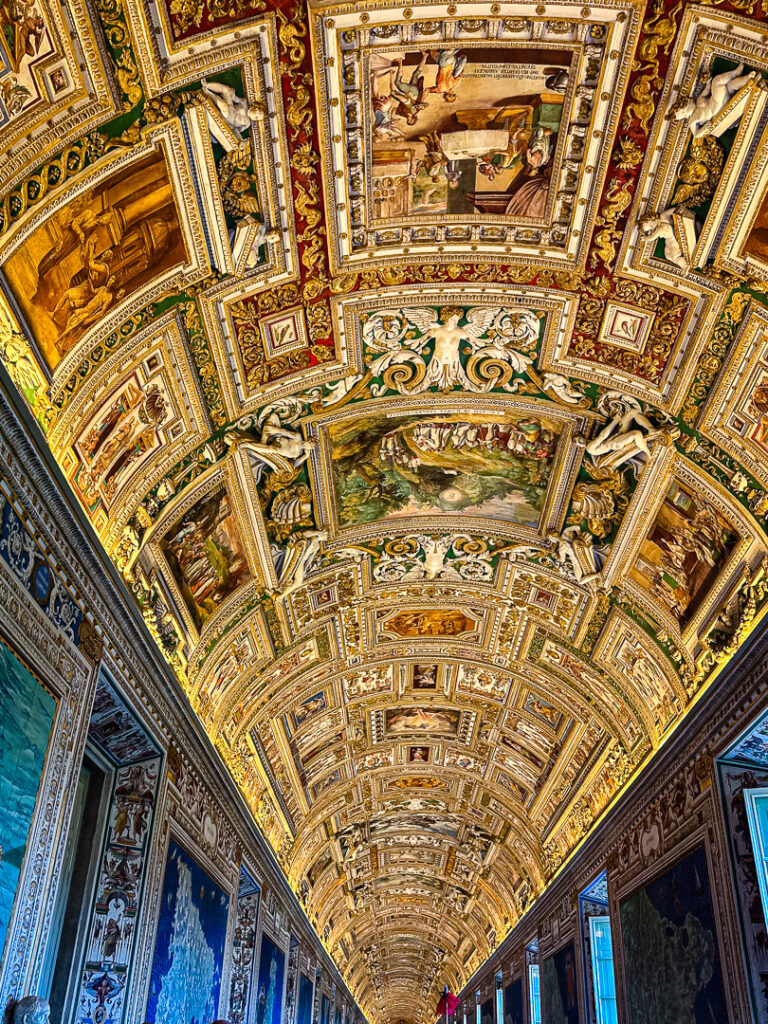
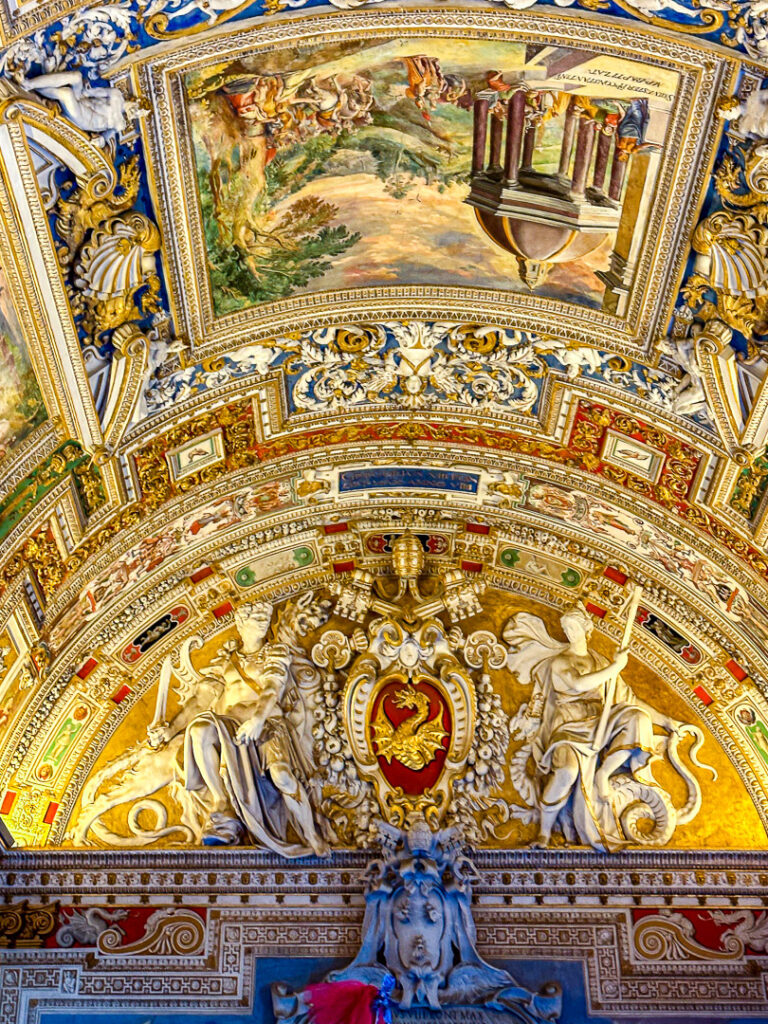
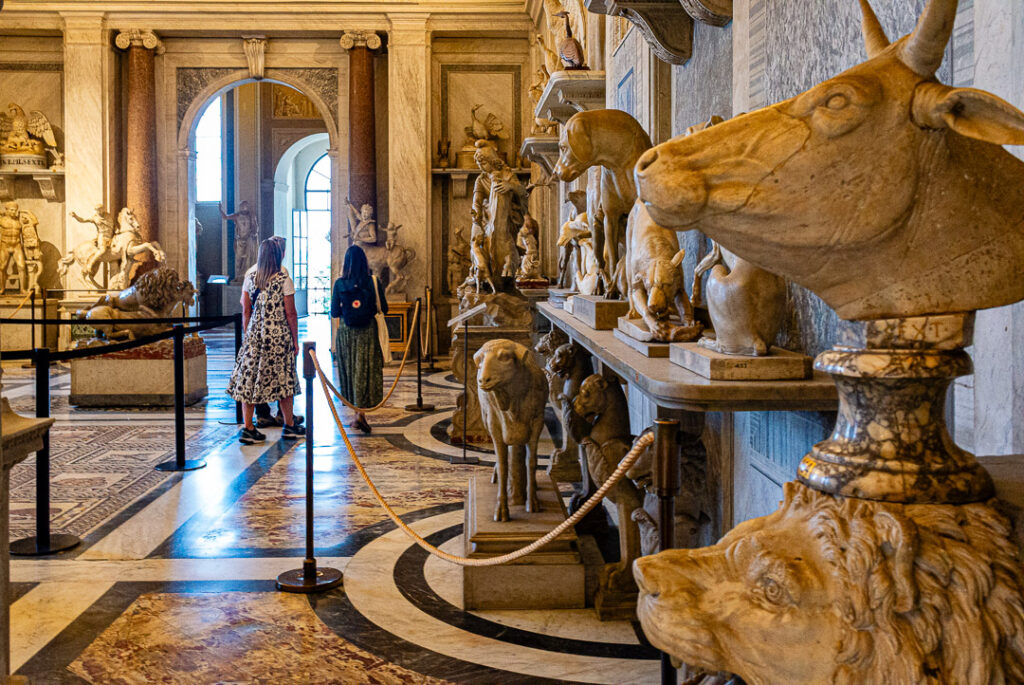
We passed through the Gallery of Tapestries, the Gallery of Maps, and paused to admire Raphael’s School of Athens, each corridor more impressive than the last. After winding through these magnificent halls, we finally reached the pièce de résistance: the Sistine Chapel.


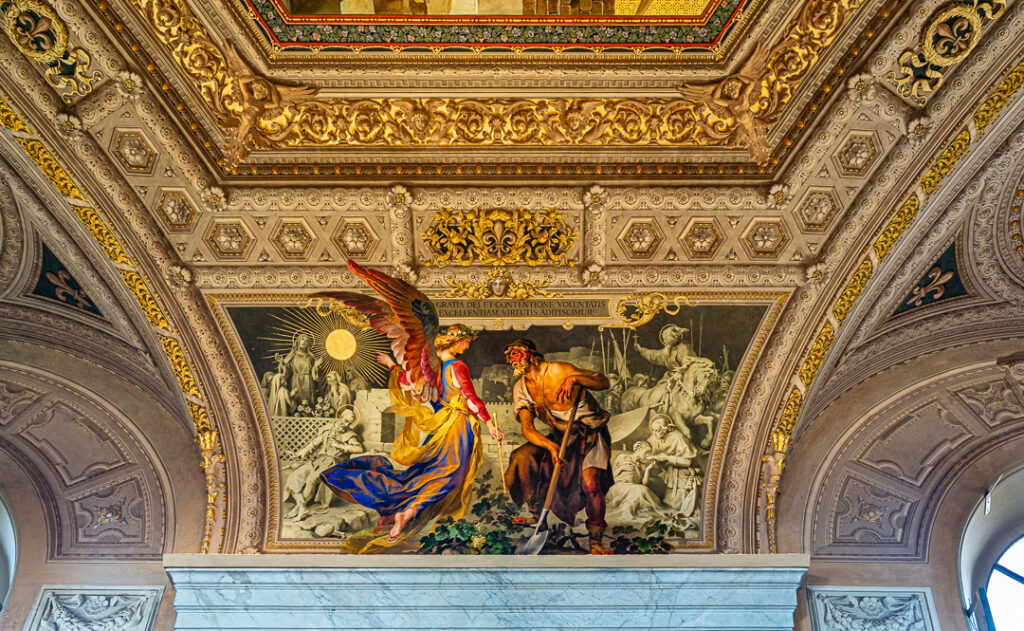
Sistine Chapel
I could try to describe the Sistine Chapel with every adjective imaginable, but nothing would do it justice. Instead, I’ll share the moment my wife truly saw it.
We’re both nearsighted with similar prescriptions, close enough that we can share glasses in a pinch. Once inside, you have to crane your neck back to take in Michelangelo’s ceiling. I happened to be wearing my prescription sunglasses, and even with the tinted lenses, every detail was crystal clear. A serious “WOW” moment.
But when I looked over at my wife, something was off. She was staring upward, but not really seeing it. Without saying a word, I slipped off my sunglasses and handed them to her.
“Put these on.”
The transformation was instant. The moment the ceiling snapped into focus, her eyes filled with tears. She stood there, head back, tears rolling down her cheeks, finally seeing what Michelangelo intended. It was one of those rare travel moments that stays with you forever.
If you’re nearsighted, bring your glasses. Don’t be the person squinting at one of humanity’s greatest artistic achievements. And maybe pack an extra pair, you might make someone’s day.
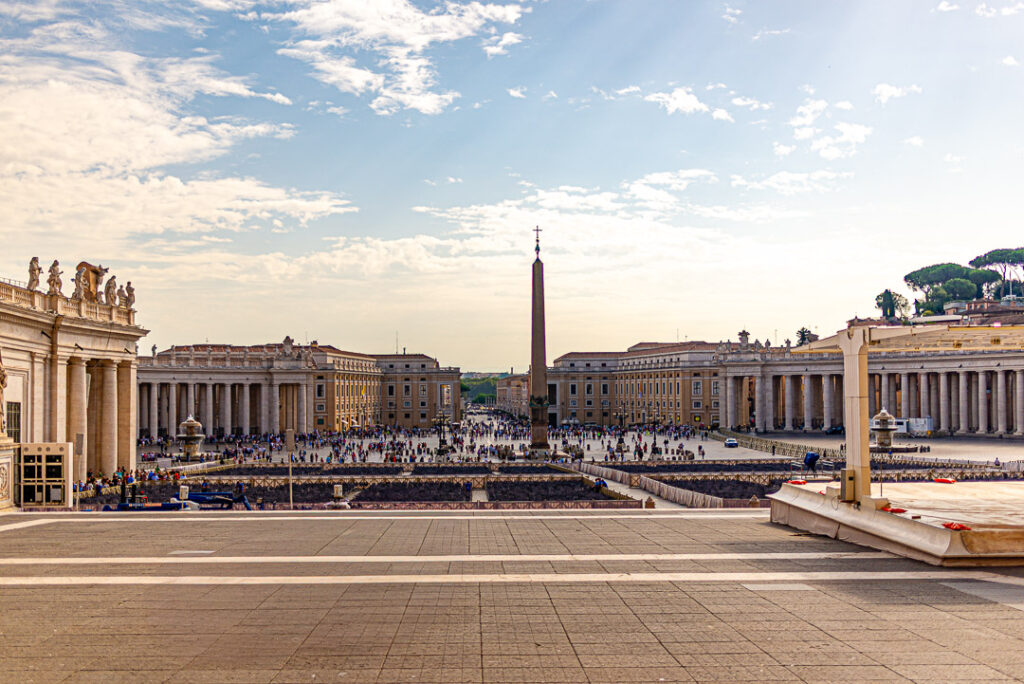
Unfortunately, no photos or videos are allowed inside, so here’s the next best thing: a virtual tour.
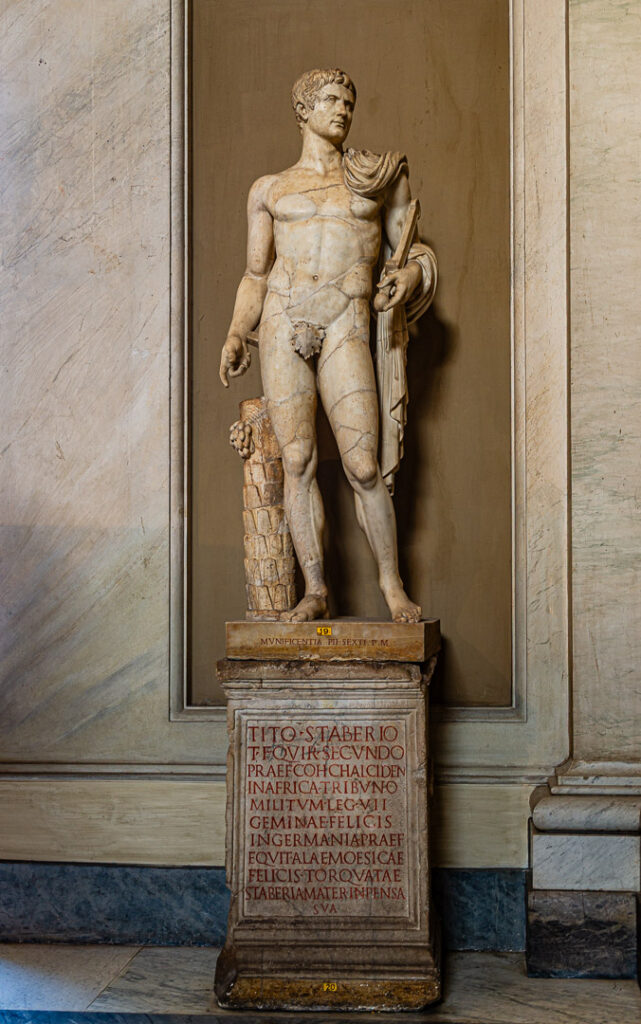
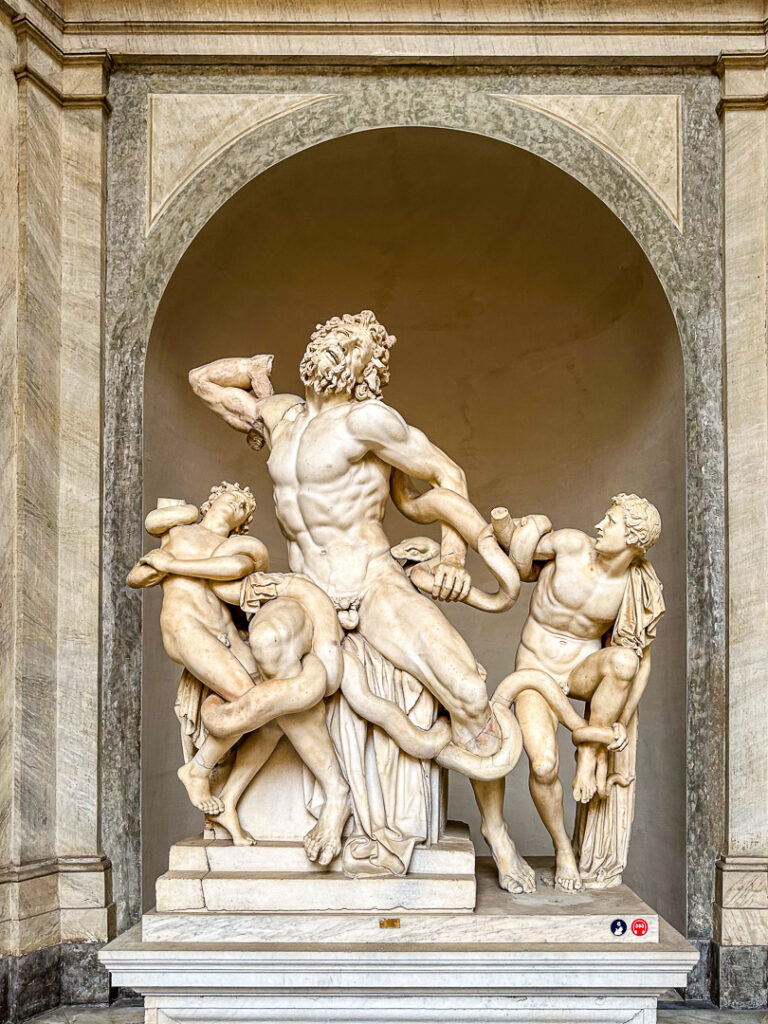

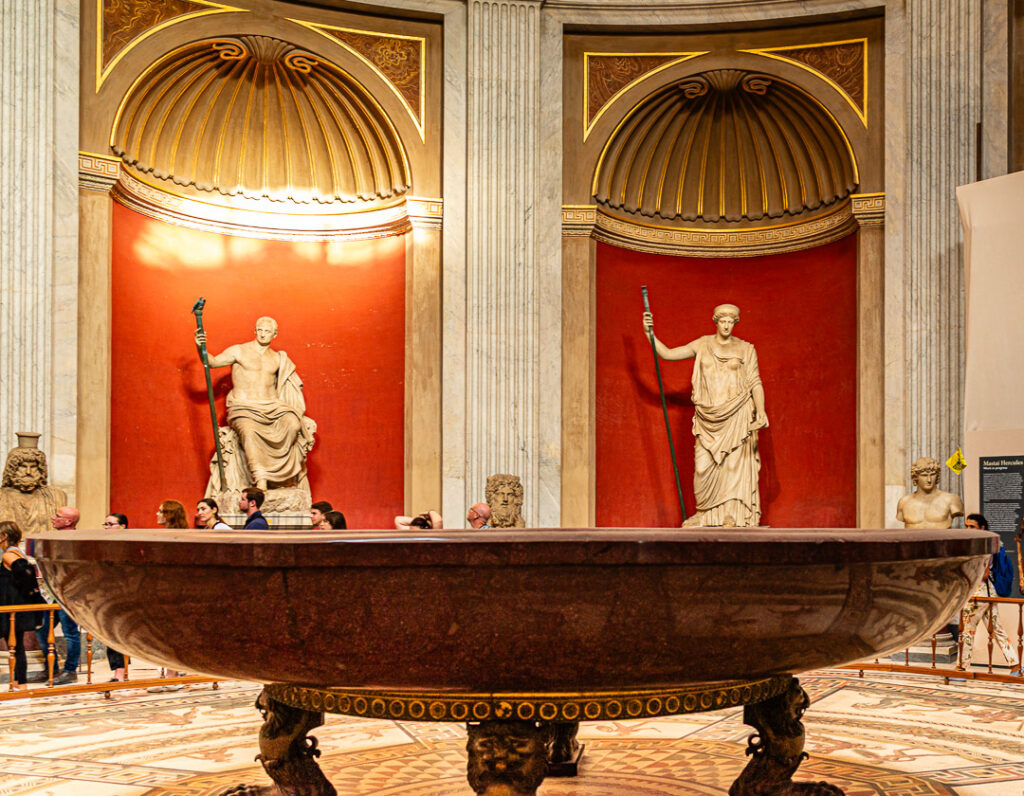


St. Peter’s Basilica
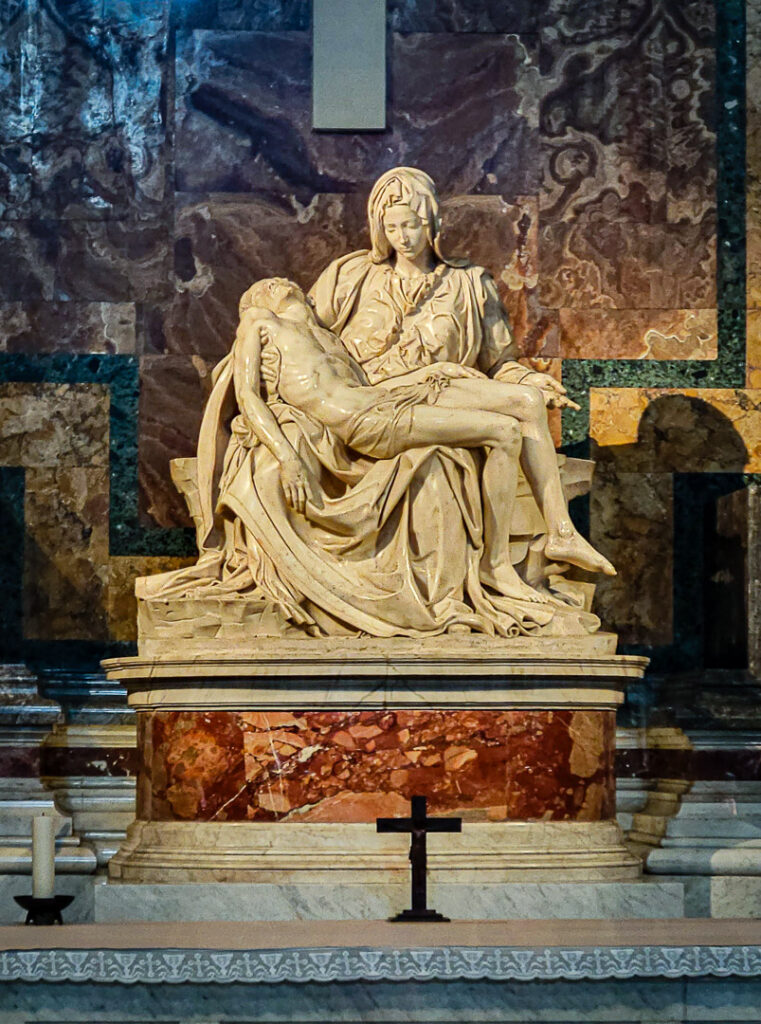
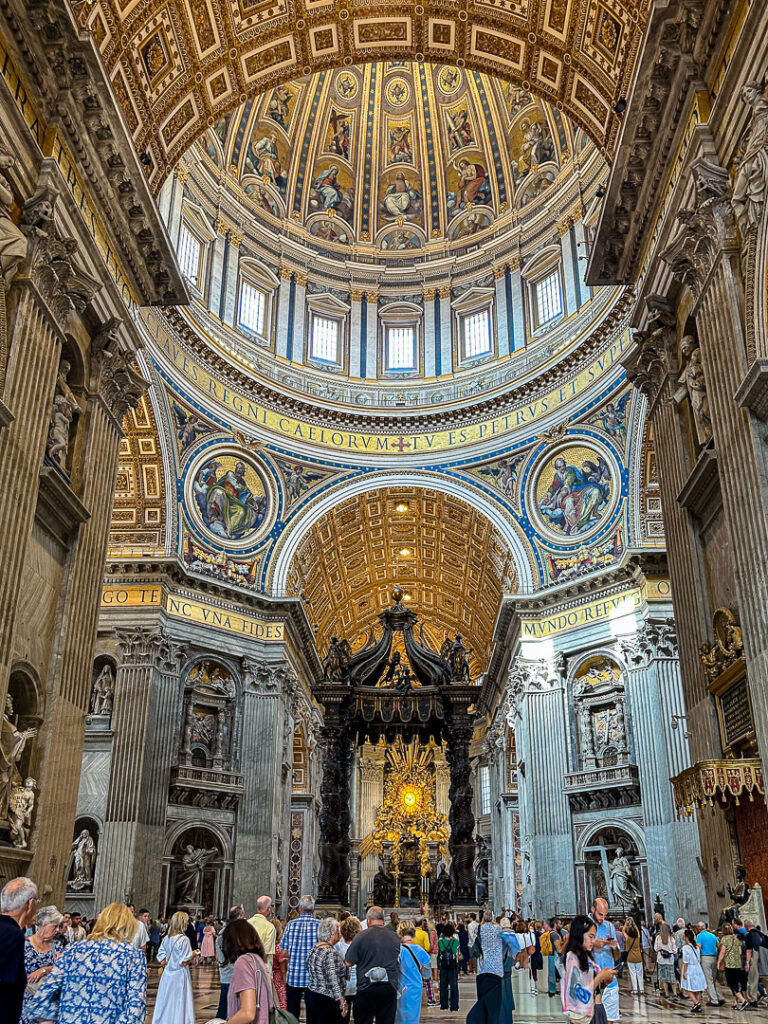
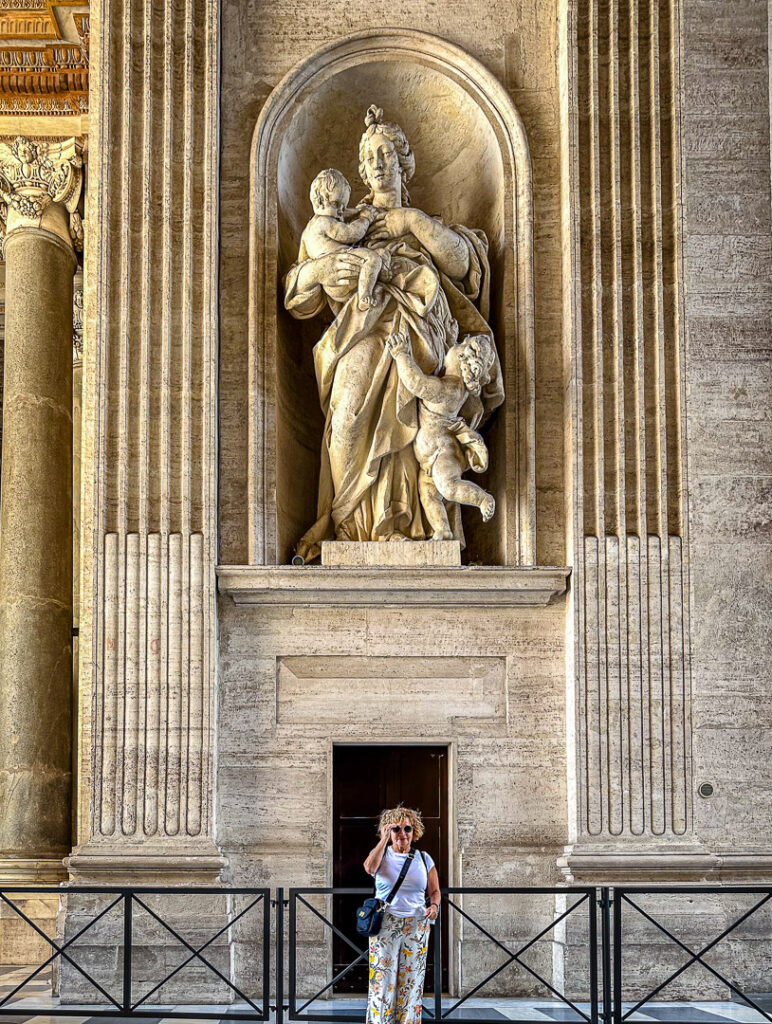
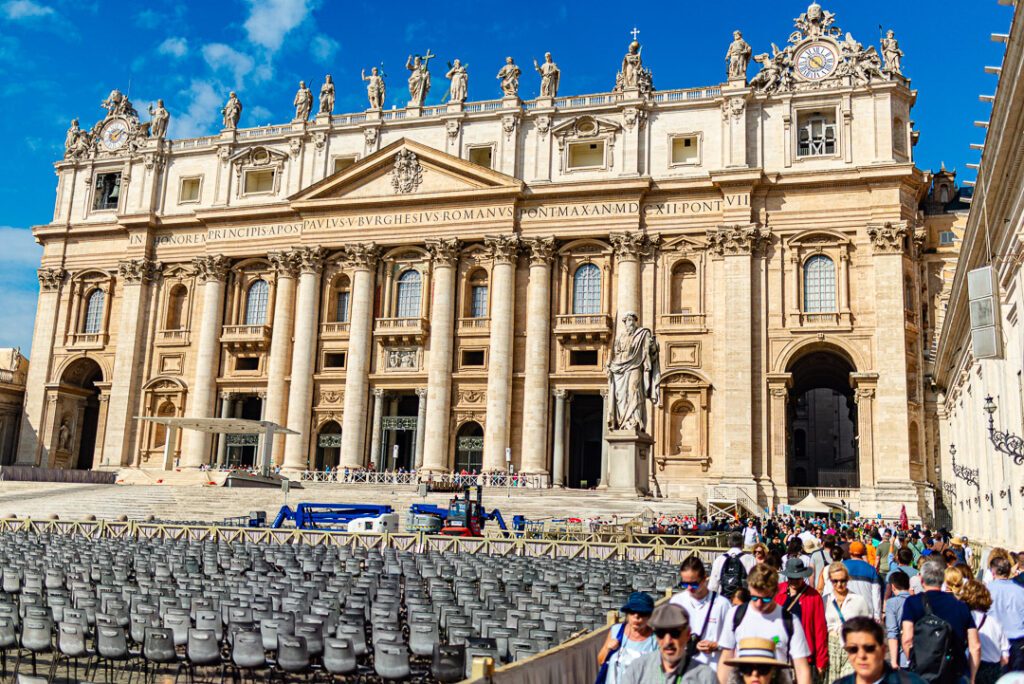
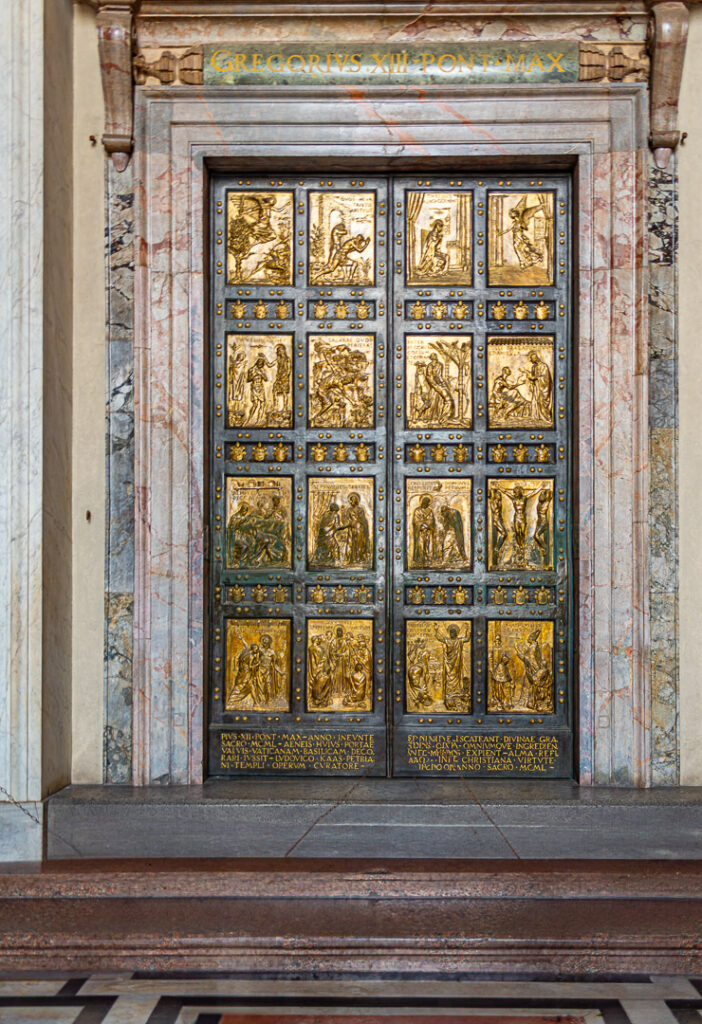
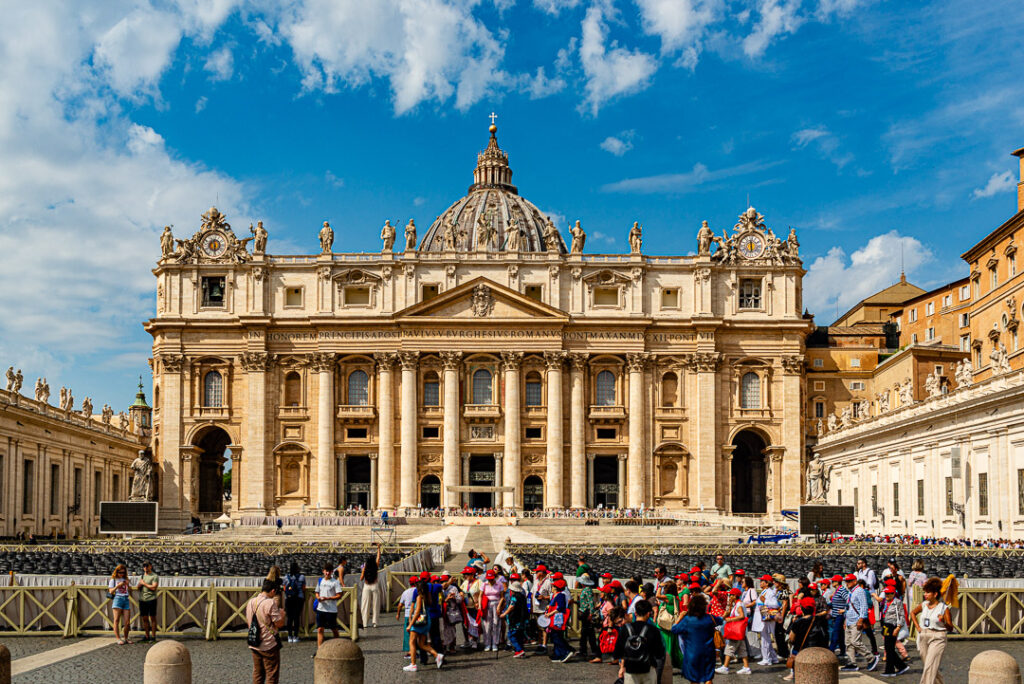
St. Peter’s Basilica is massive and disorienting, the kind of place where you walk in and immediately think, Which way do I even go? Here, our guide redeemed herself a bit, slowing down and making sure we didn’t miss key details, including Michelangelo’s Pietà, which is easy to overlook in such an enormous space.
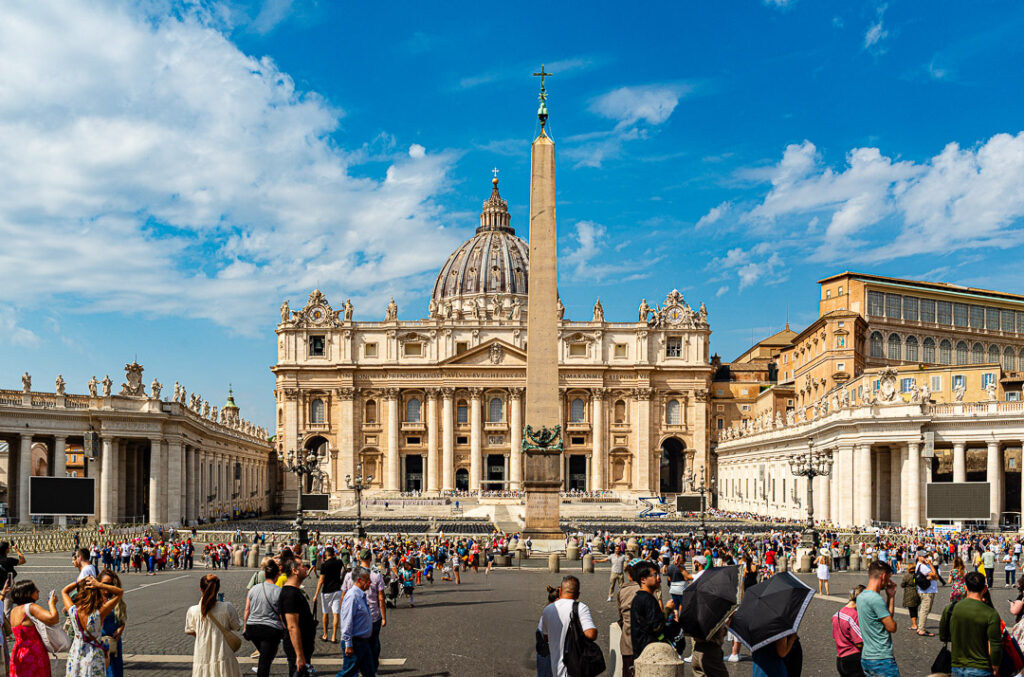
We ended the tour with a walk through the Vatican Grottoes, then stepped out into St. Peter’s Square for final photos. Another family from our group offered to take a picture of all of us, a small gesture that wrapped up the morning on a warm note.
Dress Up Dinner Disappointment
For our last night in Rome, we planned a dress-up dinner at Antica Pesa, hoping for a memorable, formal Italian dining experience before our cruise. Unfortunately, the evening fell flat. What should have been a special night was disappointing across the board, from the service to the food to the overall atmosphere.
If you’re curious about the details, I wrote a full review here.
Capturing Rome in the Quiet Hours
After dinner, we grabbed a taxi back to the hotel and started packing for our departure the next day. We said our goodnights and drifted off, or at least everyone else did.
After what felt like a short nap, I woke up wide awake. No amount of counting was getting me back to sleep. Between the drunk people on the street below, the occasional siren, and the snoring (oh man, the snoring), I didn’t stand a chance.
Eventually, I gave up. I got dressed, grabbed my camera, and headed out to explore Rome at 2 a.m., a version of the city most tourists never see.
Sure, I wished I had brought a wider lens, but honestly, it wasn’t about the gear. It was about the experience. And surprisingly, even at that hour, Rome wasn’t empty. I crossed paths with fellow photographers, the after‑party crowd, late‑night romantics, and everyday Romans making their way home.
Walking through Rome’s iconic streets in near silence, places that are usually jam‑packed during the day, was unforgettable. It felt like the city was letting me in on a secret.


Civitavecchia Port: Boarding Our Mediterranean Cruise
Morning Start
After my late‑night photo adventure, I strolled back into the hotel just as the sky was beginning to lighten. The concierge shot me a raised‑eyebrow look, the universal “What on earth have you been up to?” and I couldn’t help but laugh.
Back in the room, I showered, stepped out onto the balcony with an espresso, and enjoyed a quiet moment before the day officially began. Eventually, the rest of the family woke up, went through their routines, and soon we were all downstairs enjoying breakfast together.
The Drive to Civitavecchia
By noon, we were in a van heading toward Civitavecchia, the port city where most Mediterranean cruises from Rome begin. As Rome slowly faded behind us, the scenery shifted from urban chaos to coastal calm. In the back seat, my mom, aunt, and wife chatted excitedly about the cruise ahead.
I rode shotgun with the driver, proudly wearing my loud surfing Batman‑and‑Joker shirt, my unofficial signal that cruise mode had officially kicked in. The driver spoke decent English, and we chatted about his day‑to‑day life and how much Rome has changed over the past five years. By the time we reached the port, I was more than ready for sail‑away and champagne.
Arrival and Check‑In
Getting through the port was a bit of a challenge, lots of people, lots of lines, but eventually we made it to the luggage drop‑off. Check‑in went smoothly, and it was fun watching travelers from all over the world converge in one place. I’ll never forget a family of seven in matching bright‑orange tropical button‑downs, laughing and having the time of their lives. Parents, adult kids, their partners, the whole crew. A perfect reminder of why people love cruising.
Stepping Aboard Odyssey of the Seas
Finally, we stepped aboard Royal Caribbean’s Odyssey of the Seas. The energy hits you the moment you cross the gangway: music blaring, smiling crew members, fellow travelers buzzing with excitement. Honestly, that rush of good vibes during boarding is one of the best parts of any cruise.
Settling Into Our Aft Stateroom
We made our way to our aft stateroom, which turned out to be the perfect choice. There’s something hypnotic about watching a ship’s wake trail behind you,the steady churn of water, the endless stretch of ocean fading into the horizon. It’s easily one of the most relaxing views at sea. Aft balconies also offer some of the best vantage points when sailing out of port. I can personally say that some of the best sunsets I’ve ever seen were from that balcony.
Sailing Away From Italy
As we settled in and unpacked, we watched Italy’s coastline slowly disappear. Rome had been the introduction; now it was time for the main event, seven days, six ports, and enough Mediterranean experiences to last a lifetime.